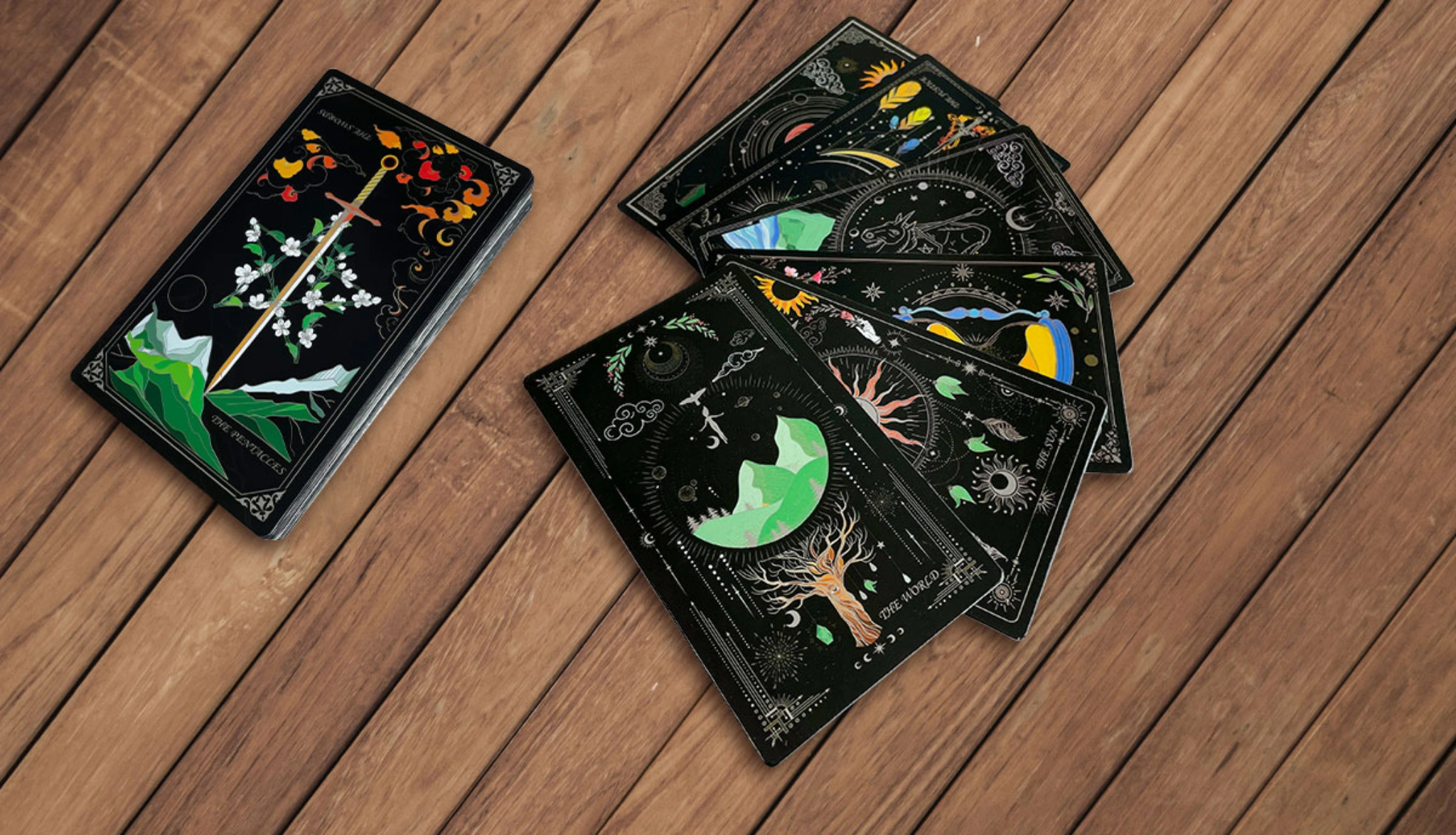
The true power of tarot reading is unlocked not just by the meaning of the individual cards, but by the structure and context provided by Tarot spreads.
A spread is the map that guides the interpretation, transforming a random collection of symbols into a coherent narrative that addresses a specific question or life situation.
This comprehensive guide serves as a practical encyclopedia for mastering Tarot spreads, detailing the logic behind their design, exploring essential layouts for every level of reader, and providing the knowledge to create your own personalized maps for self-discovery.
The Foundational Logic of Tarot Spreads
A Tarot spread is a deliberate arrangement of cards, where each position is assigned a specific meaning or context. This structure is what allows the reader to synthesize the individual Tarot meanings into a focused answer.
The Importance of Position and Context
The core principle of Tarot spreads is that the card’s meaning is modified by its position. The same card, say the Ten of Swords, will carry a drastically different message depending on where it lands:
- In the “Past” position: It signifies a painful ending that has been overcome, leading to relief.
- In the “Challenge” position: It warns that the querent is currently facing a rock-bottom moment or feeling victimized.
- In the “Advice” position: It suggests that the best course of action is to accept the finality of a situation and surrender to the necessary end.
This contextualization is the reason why Tarot spreads are essential tools for accurate and insightful readings [1].
The Geometry of Tarot Spreads
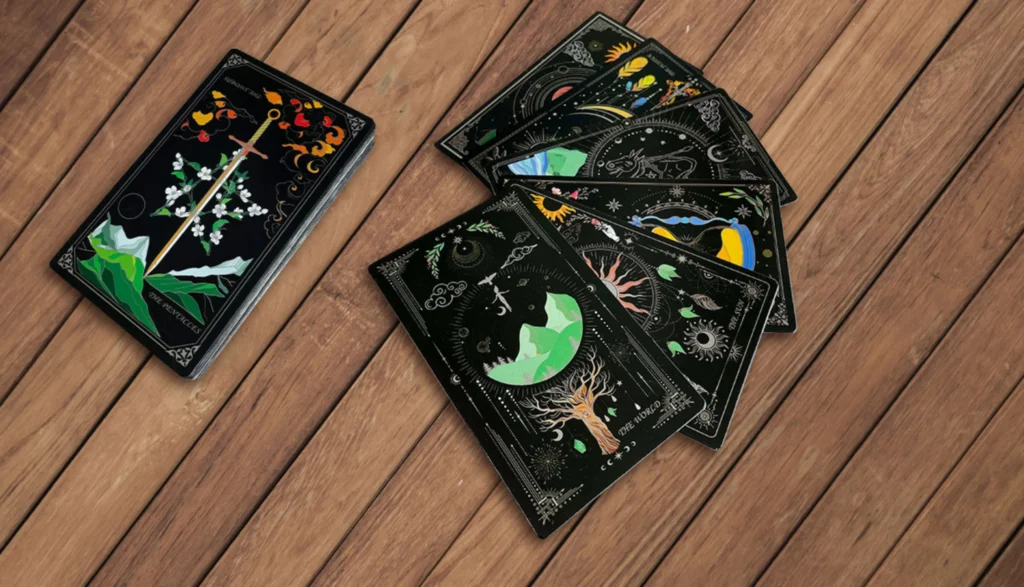
The physical layout of Tarot spreads often carries symbolic weight, influencing the flow of the narrative.
| Geometry | Symbolic Meaning | Example Spread |
|---|---|---|
| Linear | Progression, sequence, cause and effect. | Three-Card Spread (Past-Present-Future) |
| Cross | Conflict, intersection, the self versus external forces. | Celtic Cross Spread (Self vs. Challenge) |
| Diamond/Star | Holistic view, multi-faceted analysis, spiritual alignment. | Five-Card Star Spread |
| Circular | Cycles, completion, continuous flow, life lessons. | Wheel of the Year Spread |
Essential Tarot Spreads for Beginners
For those new to tarot reading, starting with simple Tarot spreads is crucial for building confidence and intuitive connection.
1. The Single-Card Draw (Daily Tarot)
The simplest and most powerful of all Tarot spreads. It is the foundation of the daily tarot practice.
- Positions: 1 (The Theme/Advice for the Day).
- Best For: Quick clarity, daily focus, setting an intention, and building a relationship with the deck.
2. The Three-Card Spreads (The Versatile Map)
The three-card layout is the most versatile of all Tarot spreads, easily adapted to any question by simply changing the position labels.
| Spread Name | Card 1 | Card 2 | Card 3 |
|---|---|---|---|
| Time Flow | Past | Present | Future |
| Decision Making | Option A | Option B | Advice |
| Self-Growth | Body | Mind | Spirit |
| Relationship | Me | You | The Relationship |
| Problem Solving | Situation | Challenge | Resolution |
This flexibility makes the three-card layout an indispensable tool for any reader.
3. The Five-Card Cross (The Quick Overview)
A slightly more complex layout that provides a quick, holistic view of a situation, ideal for when the querent needs a balanced perspective.
- Card 1 (Center): The Present Situation.
- Card 2 (Left): The Past/Root Cause.
- Card 3 (Right): The Future/Potential Outcome.
- Card 4 (Top): Conscious Awareness/Goals.
- Card 5 (Bottom): Unconscious Influences/Foundation.
Advanced Tarot Spreads for Deep Analysis
As the reader gains experience, more complex Tarot spreads are necessary to address multi-layered questions and deep psychological work.
4. The Celtic Cross Spread (The Classic Blueprint)
The Celtic Cross is arguably the most famous and comprehensive of all Tarot spreads. It uses ten cards to provide a detailed, multi-faceted analysis of a complex situation, making it ideal for major life decisions or periods of significant uncertainty.
| Position | Meaning | Focus |
|---|---|---|
| 1 & 2 | The Present & The Challenge | The core issue and the obstacle crossing it. |
| 3 & 4 | The Foundation & The Past | The deep roots of the issue and recent history. |
| 5 & 6 | The Conscious & The Future | What the querent knows and the immediate path ahead. |
| 7 – 10 | The Staff (Outcome) | The querent’s attitude, external influences, hopes/fears, and the final outcome. |
Mastering the Celtic Cross requires not only knowing the Tarot meanings but also understanding how the ten cards interact to form a single, cohesive narrative.
5. The Relationship Blueprint (The Partner Spread)
A seven-card spread designed specifically for love tarot, focusing on the dynamic between two people.
- Card 1 (Me): My current energy and feelings.
- Card 2 (You): My partner’s current energy and feelings.
- Card 3 (Foundation): The core strength of the relationship.
- Card 4 (Challenge): The main issue facing the relationship.
- Card 5 (Advice): The best action for the querent to take.
- Card 6 (Potential): The relationship’s potential for growth.
- Card 7 (Outcome): The likely future of the relationship.
Specialized Tarot Spreads for Modern Life
Modern tarot reading has evolved to include Tarot spreads tailored for specific, contemporary issues, moving beyond traditional questions of love and money.
6. The Shadow Work Spread (The Inner Mirror)
Designed for deep psychological exploration, this spread helps the querent integrate their unconscious, repressed aspects.
- Card 1: What part of my Shadow needs my attention right now?
- Card 2: Why is this part of me hidden (the root cause)?
- Card 3: How does this Shadow aspect manifest in my daily life?
- Card 4: What is the gift or lesson hidden within this Shadow?
- Card 5: How can I begin to integrate this aspect for wholeness?
7. The Decision-Making Spread (The Clarity Map)
A practical spread for when the querent is faced with two distinct paths.
- Card 1 (Center): The core issue or question.
- Card 2 (Left): The path of Option A (its energy and potential).
- Card 3 (Right): The path of Option B (its energy and potential).
- Card 4 (Bottom): The hidden factor or advice common to both options.
- Card 5 (Top): The most likely outcome if no choice is made (stagnation).
The Art of Creating Your Own Tarot Spreads
The ultimate mastery of Tarot spreads is the ability to design a custom layout that perfectly matches the querent’s unique question. This process requires a clear understanding of the reading’s objective and the logical flow of the narrative.
Step-by-Step Guide to Custom Tarot Spreads
- Define the Question: Be specific. Instead of “What about my job?”, ask “What is the best way for me to communicate my value to my boss this week?”
- Break Down the Narrative: Deconstruct the question into its essential components. For the example above, the components are: My Current Energy, My Boss’s Perspective, The Best Communication Strategy, The Potential Outcome.
- Assign Positions: Each component becomes a position in the spread.
- Choose the Geometry: A linear or diamond shape works well for this type of question.
- Label Clearly: Write down the position labels before drawing the cards. This intentionality focuses the energy of the reading and ensures that the resulting Tarot spreads are highly relevant.
| Component | Position Label |
|---|---|
| Self | Card 1: My Current Energy |
| Other | Card 2: My Boss’s Perspective |
| Action | Card 3: The Best Communication Strategy |
| Result | Card 4: The Potential Outcome |
Integrating Tarot Spreads into Your Practice
To move from simply laying out cards to truly mastering Tarot spreads, the reader must focus on the synthesis of the entire layout.
Reading the Story, Not Just the Cards
A common mistake is to read each card in isolation. The true insight comes from seeing how the cards interact. Look for:
- Repeating Suits: A cluster of Cups indicates an emotional issue; a cluster of Pentacles indicates a material or financial focus.
- Major Arcana Dominance: A spread dominated by Major Arcana suggests the issue is a major life lesson or karmic event.
- Directional Flow: In the Celtic Cross, observe the flow from the Past (Card 4) to the Future (Card 6) and how the Challenge (Card 2) is resolved in the Outcome (Card 10).
The Tarot spreads are designed to create a story. The reader’s job is to articulate that story clearly and compassionately.
The Role of the Significator
In some Tarot spreads, a Significator card is chosen beforehand to represent the querent or the core issue. While optional, using a Significator (often a Court Card or a Major Arcana card like The Fool or The Magician) helps to anchor the energy of the reading and focus the interpretation of the surrounding cards.
arot Spreads as the Map to Self-Discovery
Tarot spreads are the essential architecture of a meaningful tarot reading. They provide the necessary structure to channel the infinite wisdom of the 78 cards into a finite, actionable message.
From the simplicity of the single-card draw to the complexity of the Celtic Cross, each layout serves as a unique map for navigating the terrain of life.
By mastering the logic of position, understanding the geometry of the layouts, and developing the skill to create custom Tarot spreads, the reader transforms their practice from a random draw into a precise, powerful tool for self-discovery, decision-making, and profound personal growth. The map is laid out; all that remains is to read the journey.
References
[1] Labyrinthos. The Celtic Cross Tarot Spread – A Classic 10 Card….
[2] Biddy Tarot. 25 Easy Three-Card Tarot Spreads.
[3] Women’s Health Mag. How To Do Beginner Tarot Card Spreads, According To….
[4] Labyrinthos. How to Create Your Own Tarot Spreads: A Step-by-Step Guide….
[5] Mary K. Greer. Three-Card Spreads: The Essentials (and more).
[6] Labyrinthos. Tarot Spreads for Love, Career, Spiritual, and More.
[7] Hermit’s Mirror. Tarot Spread: Starting on Shadow Work.
[8] Wayneneo. Understanding Tarot Spreads: Which Layout is Best for….
[9] Carrie Mallon. Decoding the Celtic Cross.
[10] Incandescent Tarot. Making Your Own Tarot Spreads.
Advanced Techniques for Interpreting Tarot Spreads
Moving beyond the basic interpretation of individual cards, advanced readers focus on the holistic message of the entire Tarot spread. This involves recognizing patterns, identifying dominant themes, and understanding the energetic flow of the layout.
Recognizing Dominant Patterns in Tarot Spreads
When analyzing a Tarot spread, look for the following patterns to quickly grasp the core message:
- Suit Dominance: A spread heavily populated by one suit (e.g., Swords) indicates that the situation is primarily driven by the element associated with that suit (e.g., intellect, conflict, communication). The reader should focus the interpretation on mental processes and clarity.
- Arcana Dominance:
- Major Arcana: The issue is a major life lesson, a karmic event, or a profound spiritual shift. The focus should be on the archetypal meaning and the long-term impact.
- Minor Arcana: The issue is a temporary, day-to-day challenge that is manageable and changeable. The focus should be on practical advice and immediate action.
- Court Cards: The issue revolves around personalities, roles, or the need to embody a specific type of energy (e.g., the authority of a King or the curiosity of a Page).
- Numerical Patterns: Repeated numbers across different suits (e.g., Three of Wands, Three of Cups, Three of Pentacles) suggest a theme of initial growth, formation, or collaboration is central to the reading.
The Flow of Energy in Tarot Spreads
In many Tarot spreads, especially those with a directional flow (like the Celtic Cross or a linear spread), the reader should observe how the energy moves from one card to the next.
- Positive Flow: If a challenging card (e.g., Five of Swords) is followed by a healing card (e.g., Four of Swords), the flow indicates that the querent is moving from conflict to rest.
- Negative Flow: If a positive card (e.g., Ten of Cups) is followed by a challenging card (e.g., Five of Cups), the flow warns that the current happiness is at risk of being lost due to emotional disappointment.
By treating the Tarot spread as a dynamic system rather than a static collection of symbols, the reader can provide a narrative that is both predictive of potential and empowering in its advice.
The mastery of Tarot spreads is ultimately the mastery of storytelling through the language of the cards.






1 Comment
Thank you for your post.
Your comment is awaiting moderation.
[…] The Limitations and Ethics of Yes or No Tarot […]