You know the feeling. Your mind is moving faster than you can keep up with, cycling through worst-case scenarios, replaying conversations that are finished, or predicting problems that may never arrive.
It’s exhausting — and what makes it harder is that trying to think your way out of anxious thinking almost never works. The mind that’s creating the spiral is the same one you’re asking to solve it.
Tarot for anxiety relief is not a cure. It cannot stop the anxious thoughts or eliminate the patterns that create them.
What it can do — when approached thoughtfully and without expectation of magic — is create a pause. A moment where you stop reacting and start noticing.
A structured space to name what you’re actually feeling, identify what’s driving the anxiety, and choose one small, grounded step toward the present rather than deeper into the spiral.
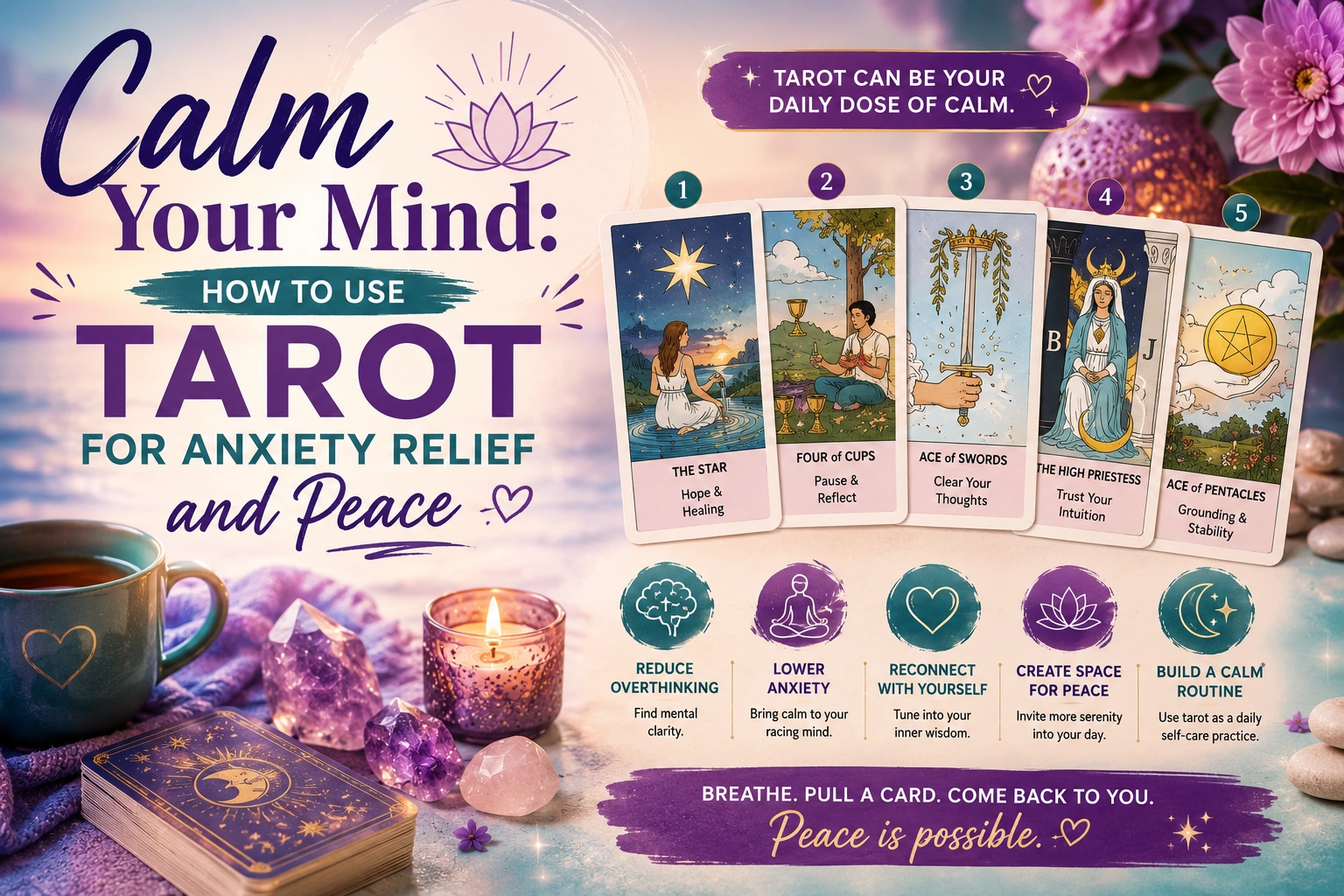
This guide will show you how to use tarot as a gentle reflective companion during anxious moments — through a 5-card anxiety spread, a simpler 3-card grounding version, the cards most associated with calm and anxiety, and the grounding practices that make the whole practice safe and genuinely useful.
Important: Tarot is not a medical treatment, a diagnostic tool, or a substitute for therapy, medication, or crisis support. If you are experiencing significant anxiety, panic attacks, depression, or thoughts of harming yourself or others, please reach out to a licensed mental health professional or crisis service.
This article is for general self-reflection purposes only and does not constitute mental health advice.
Can Tarot Help With Anxiety Relief?
Tarot as a Pause From Racing Thoughts
Anxiety frequently operates through speed — the faster the thoughts spiral, the harder it becomes to step back and assess them clearly. Tarot for anxiety relief works precisely because it creates friction against that speed.
The physical act of shuffling, the deliberate choice of a card, the moment of genuinely looking at an image and asking what it means — these are inherently slowing activities. They interrupt the automatic, accelerating quality of anxious thought and create a moment of genuine presence.
That pause is not nothing. In many evidence-based approaches to anxiety — including mindfulness-based cognitive therapy — the ability to create a gap between stimulus and response is one of the core skills being developed.
Tarot, approached mindfully, offers one accessible way to practice that gap.
How Reflection Can Support Emotional Clarity
Anxiety often generates a sense of undifferentiated overwhelm — everything feels threatening, urgent, or unmanageable simultaneously. Tarot provides a structure for differentiation: this card speaks to what I’m feeling, this one to what’s driving the fear, this one to what I can actually do.
This kind of structured reflection doesn’t eliminate anxiety, but it consistently reduces the quality of overwhelm by giving the experience specific form and name.
Why Tarot Should Not Replace Therapy or Treatment
Tarot is a self-reflection tool. It is not psychotherapy, it is not evidence-based treatment, and it is not a substitute for the professional support that clinical anxiety often genuinely requires.
If your anxiety is persistent, significantly interfering with your daily functioning, or associated with panic attacks, depression, trauma responses, or obsessive thinking patterns, please work with a licensed mental health professional. Tarot can be a meaningful complementary practice alongside professional treatment — it cannot replace it.
When Anxiety Needs Professional or Urgent Support
If you are experiencing thoughts of harming yourself or others, call or text 988 (Suicide and Crisis Lifeline) in the U.S. If you are in immediate danger, call 911.
Crisis Text Line: text HOME to 741741. These services are free, confidential, and available 24/7.
Beyond crisis situations, please reach out to a therapist or doctor if your anxiety is persistent, making it difficult to function in daily life, associated with significant physical symptoms, or something you haven’t been able to address through self-reflection or social support alone. Seeking professional help is an act of self-care, not a sign of failure.
Tarot for Anxiety Relief: A Gentle 5-Card Spread
This 5-card anxiety tarot spread is designed to be used during moments of heightened anxiety or overthinking — not to predict outcomes or explore future scenarios, but to create clarity about what’s present right now and what one grounded next step might look like. Pull all five cards only after you’ve done a brief grounding practice (see the next section).
Card 1: What Am I Feeling Right Now?
This first card names the emotional reality of the present moment — not what you think you should be feeling or what would be rational to feel, but what is actually present in your experience right now. Read the suit first: Cups indicates primarily emotional anxiety; Swords indicates anxious thought patterns or mental pressure; Pentacles suggests worry about practical or material matters; Wands may indicate anxiety around action, direction, or self-expression.
Whatever appears, read it with compassion rather than judgment. The card is naming what’s there, not amplifying it.
Card 2: What Thought Is Increasing My Anxiety?
The second card names the specific cognitive pattern most actively driving the anxiety in this moment — not every anxious thought, but the one that is doing the most work. The Eight of Swords often appears here (I am trapped and there is no way forward), as does the Nine of Swords (catastrophic anticipation), The Moon (fear of what is uncertain and unknown), or the Two of Swords (forced choice between two frightening options).
Whatever appears, ask specifically: what thought pattern does this card describe? Naming the thought is the first step to examining whether it’s actually true.
Card 3: What Do I Need to Remember in This Moment?
The third card carries the most directly supportive message of the spread — the reminder that anxiety most commonly overrides or obscures. This might be a reminder of your own resilience (Strength), a reminder that the uncertainty you’re facing doesn’t determine your response to it (Temperance), a reminder that rest is available and legitimate (Four of Swords), or a reminder that the situation is not as fixed or hopeless as the anxious mind is insisting (Ace of Swords).
Read this card as a message from the clearest, most grounded part of yourself.
Card 4: What Can Help Me Feel More Grounded?
The fourth card names a specific type of action, practice, or orientation that can help you return to a more grounded state right now — not in the abstract, but in this specific moment. Pentacles cards here suggest something physical and material: go outside, eat something, move your body, complete a small practical task.
Cups suggest emotional connection: talk to someone, allow yourself to feel what’s present, offer yourself compassion. Swords suggest cognitive reframing: write down the anxious thought, challenge it with evidence, or simply acknowledge it without acting on it.
Whatever appears, translate it into the most specific, immediately actionable grounding practice available to you right now.
Card 5: What Is One Small, Caring Next Step?
The final card names the most concrete, immediately actionable, genuinely caring thing you can do in the next few hours — not to solve the anxiety entirely, but to take one step that supports your wellbeing. This is not a grand resolution or a complete treatment plan.
It is one small, kind, realistic thing. Whatever card appears, translate it into the most specific possible action.
Then do it. That action is the bridge between the reading and genuine self-care.
How to Use This Anxiety Tarot Spread Safely
How you approach a tarot spread during an anxious moment matters significantly. These seven steps help ensure the reading supports grounding rather than deepening the spiral.
Step 1: Check In With Your Body First
Before touching the cards, pause and notice your physical state. Are you breathing shallowly?
Is your chest tight? Are your hands clenched?
Take three slow, deliberate breaths — long exhale, longer than the inhale — and allow your shoulders to drop. If you’re in acute distress or a panic state, the grounding practices at the end of this article are a better first response than tarot.
Use the spread when you’re anxious but functional, not when you’re in crisis.
Step 2: Set a Gentle Intention
Rather than pulling cards from a state of urgency or demand (“tell me whether everything will be okay”), set a gentle, grounded intention: “Help me see what I’m feeling clearly, and find one small step forward.” This reorients the reading from prediction to presence — which is both more honest and more genuinely calming.
Step 3: Avoid Asking Fear-Based Prediction Questions
The questions most likely to increase rather than reduce anxiety in a tarot reading are outcome-prediction questions: Will this work out? Is something bad going to happen?
Will they leave? These questions feed directly into the spiral rather than interrupting it.
Anchor your questions in the present moment and in what is within your own control.
Step 4: Pull the Cards Slowly
Shuffle at a pace that feels deliberately unhurried. Pull each card one at a time.
Pause between cards. If the reading is moving quickly and feeling urgent, that urgency is itself information — it’s the anxiety driving the pace rather than genuine inquiry.
Slow down deliberately.
Step 5: Interpret With Compassion, Not Judgment
Resist the reflexive impulse to immediately reframe, explain away, or find the silver lining in a difficult card. Also resist the impulse to amplify its difficulty.
Read what the card is naming as information, approached with the same gentle honesty you’d bring to a friend describing a similar situation. The cards in an anxiety reading are not verdicts — they are mirrors.
Step 6: Journal One Practical Takeaway
After the reading, write down one specific, realistic, kind thing the reading is pointing you toward. Not a resolution of the entire anxiety — one step.
What did Card 5 suggest? What did Card 3 remind you of?
The journaling step moves the reading from interesting insight into genuine self-care.
Step 7: Pause the Reading If You Feel More Distressed
If at any point during the reading your anxiety is increasing rather than finding any orientation or clarity, stop. Put the cards away.
Use one of the grounding practices at the end of this article. Contact someone you trust.
A tarot reading that is increasing your distress is not serving its purpose — it’s okay to close it and choose a different form of support.
Best Tarot Questions for Anxiety and Overthinking
What Emotion Needs My Attention Right Now?
A present-moment question that interrupts the forward-projecting quality of anxiety and anchors attention in what is actually happening right now rather than what might happen later.
What Fact Can Help Me Feel More Grounded?
Anxiety frequently involves distorted or catastrophic thinking that departs from what is actually, demonstrably true. This question asks the cards to point toward what is factually solid and reliable in the current situation.
What Am I Assuming Without Evidence?
One of the most cognitively useful anxiety questions available — it addresses the specific pattern of anxious thought that generates predictions and treats them as facts. The card that appears often names the specific assumption most actively distorting the current experience.
What Is Within My Control Today?
Anxiety frequently focuses attention on what is uncertain, unknown, or outside of personal control. This question explicitly redirects it toward what is actionable — which is both more practical and more genuinely calming than the alternative.
What Would Self-Compassion Look Like Here?
This question invites a shift from the harsh self-assessment that anxiety often generates (I should be able to handle this, what is wrong with me) toward the more productive and realistic orientation of compassionate self-support.
What Support Would Help Me Feel Safer?
A direct, practical question about what type of support — from yourself, from others, from professional resources — would most genuinely help in this moment. The card that appears often names a specific type of connection or support that the anxiety has been preventing.
What Small Action Can I Take Instead of Spiraling?
The most immediately actionable question in any anxiety reading — it explicitly offers the spiral an alternative and asks the cards to name specifically what that alternative might be.
Tarot Cards That Can Support Calm and Inner Peace
Temperance: Balance, Patience, and Emotional Regulation
Temperance is one of the most healing cards in any anxiety reading. Its fundamental message is moderation and integration — the recognition that extreme states, including extreme anxiety, can be moderated by the patient, deliberate work of bringing opposing elements into balance.
When Temperance appears, it often asks: what would be the most measured, calm, integrated response available to you right now?
Four of Swords: Rest, Recovery, and Mental Space
The Four of Swords is tarot’s direct prescription for rest — the figure lying in peaceful stillness, swords put aside, mind allowed to quiet. In an anxiety reading, this card is sometimes the single most important one that can appear.
It says: not everything needs to be resolved right now. Rest is not avoidance — it is the legitimate, necessary space in which mental recovery becomes possible.
The Star: Hope, Healing, and Renewal
The Star carries perhaps the most important message an anxious mind can receive: things can genuinely improve, and the process of healing is already underway even when it’s not visible. It doesn’t promise instant relief.
It offers sustained, quiet hope — the kind that doesn’t require certainty, just the willingness to stay open.
The Hermit: Quiet Reflection and Inner Guidance
The Hermit in an anxiety reading speaks to the wisdom available in stillness and solitude — the guidance that arises when the noise of anxious thought is quieted enough to hear the quieter, more reliable signal beneath it. When The Hermit appears, the invitation is to step out of the noise and spend time with your own deepest, most grounded knowing.
Six of Swords: Moving Toward Calmer Waters
The Six of Swords is one of the most reassuring cards in an anxiety reading. It shows movement from turbulent to calmer water — not a dramatic resolution, but steady, supported movement in the right direction.
When this card appears, it says: the calmer state you’re reaching for is genuine and accessible. The movement toward it is already happening.
Queen of Cups: Compassion and Emotional Awareness
The Queen of Cups models the quality of relationship with one’s own emotional experience that anxiety most disrupts — patient, compassionate attention to what is actually felt, without judgment or urgency. When she appears in an anxiety reading, she invites you to meet your own emotional experience with the same attentive gentleness you’d offer someone you deeply care about.
Ace of Cups: Emotional Renewal and Self-Care
The Ace of Cups in an anxiety reading speaks to the emotional freshness and receptivity that become available when the anxiety is met with care rather than resistance. It often appears as a message about what becomes possible when self-compassion is genuinely practiced: a moment of genuine emotional opening, a return to the present, the simple renewal of allowing yourself to receive support.
Tarot Cards That May Reflect Anxiety or Overthinking
Nine of Swords: Worry, Insomnia, and Mental Pressure
The Nine of Swords is one of the most honest anxiety cards in the deck — it depicts a figure sitting upright in bed, head in hands, in the grip of overwhelming mental anguish. When this card appears in an anxiety reading, it is naming the experience directly: the racing thoughts, the night-time worry, the sense of being overwhelmed by a mind that will not quiet.
It is not a prediction of disaster — it is an acknowledgment of genuine suffering, and an invitation to address it with both compassion and practical support.
Eight of Swords: Feeling Trapped by Fearful Thoughts
The Eight of Swords names the specific anxiety pattern of cognitive entrapment — the experience of being bound and blindfolded by your own thought patterns, surrounded by swords that form no actual physical barrier. The figure could walk out, but the blindfold prevents them from seeing the opening.
In an anxiety reading, this card asks: which thoughts are creating the sense of being trapped? And are those thoughts actually as factually solid as they feel?
The Moon: Uncertainty, Fear, and Unclear Information
The Moon in an anxiety reading speaks to the specific discomfort of genuine uncertainty — when the information available is unclear, when the path ahead is not visible, and when fear fills the gap with projections that may or may not reflect reality. It asks: how much of what you’re afraid of is what you know, and how much is what anxiety is generating in the absence of knowing?
Five of Pentacles: Isolation and Emotional Insecurity
The Five of Pentacles speaks to the anxiety that comes from a deep sense of exclusion or inadequacy — the experience of standing outside in the cold while warmth and security seem available to others. In an anxiety reading, this card often names either genuine isolation that needs practical addressing or the distorted perception of isolation that anxiety creates even when connection is actually available.
Two of Swords: Avoidance and Difficult Choices
The Two of Swords names the anxiety of forced choice and the specific discomfort of the avoidance strategy that keeps the choice frozen: the blindfold preventing genuine assessment, the swords held in perfect and exhausting balance. In an anxiety reading, this card often names what is being most actively avoided and what would become possible if the avoidance were to end.
Seven of Cups: Overwhelm, Confusion, and Too Many Possibilities
The Seven of Cups names the anxiety of overwhelm through proliferation — too many options, each one vying for attention and generating its own fear response. In an anxiety reading, this card invites the reduction of complexity: what is actually real and viable among the options anxiety is cycling through?
Focusing on one concrete reality at a time is the practical response this card is pointing toward.
How to Read Difficult Cards Without Increasing Anxiety
A Difficult Card Is Not a Prediction of Disaster
The Nine of Swords appearing in an anxiety spread does not mean disaster is coming. It means anxiety is present and significant right now.
The Tower appearing does not mean catastrophe is imminent. It means a disruption or revelation is possible, and that change — however uncomfortable — may be what the situation actually requires.
Tarot cards describe energy, not destiny. Read them as information about the present, not predictions about the future.
Separate Fear From the Card’s Actual Message
When a difficult card appears during an anxiety reading, notice whether your interpretation is coming from the card’s actual symbolic content or from the anxiety that was already present. Anxious interpretation inflates and catastrophizes.
Grounded interpretation reads what’s actually there. If you find yourself catastrophizing a card’s meaning, take a breath and ask: what does this card actually depict?
What is the simplest, most honest interpretation available?
Look for the Supportive Action in Every Reading
Every tarot card — including the most challenging ones — carries some form of guidance about what would be most useful right now. The Nine of Swords says the anxiety needs to be directly addressed, including by seeking support.
The Tower says something that isn’t working needs to end. The Moon says to slow down and wait for more clarity before acting on fear-based assumptions.
Find the action the card is pointing toward, even in difficult cards.
Avoid Repeated Readings for Reassurance
Pulling additional cards because the first card’s message was uncomfortable is the anxiety tarot equivalent of compulsive reassurance-seeking — a pattern that typically increases rather than decreases anxiety over time. The first card pulled from a genuinely grounded state is almost always the most honest and most useful.
If you find yourself pulling additional cards for reassurance, close the deck and use a grounding practice instead.
Stop and Ground Yourself When Needed
If at any point a card’s appearance increases your distress rather than providing any clarity or orientation, stop the reading immediately. Use the grounding practices in the next section.
Contact someone you trust. The tarot reading can wait — your wellbeing cannot.
A Simple 3-Card Tarot Spread for Calm
If the 5-card spread feels like too much when anxiety is high, this simplified 3-card version provides grounding in a format that even an acutely anxious mind can engage with without overwhelm.
Card 1: What Is Weighing on Me?
Name what is most present in the anxiety right now — the specific worry, feeling, or situation that is heaviest.
Card 2: What Can I Release for Now?
Name what specifically can be set aside — not permanently, but for right now. What does not actually need to be held or resolved in this immediate moment?
Card 3: What Brings Me Back to the Present?
Name one specific thing — action, awareness, or quality of attention — that helps you return to the present moment rather than continuing to spiral into what might happen.
These three questions, answered honestly and followed by the simplest possible grounding action named by Card 3, constitute a complete and genuinely useful anxiety tarot practice.
Grounding Practices to Pair With a Tarot Reading
Try Slow Breathing Before Pulling Cards
Take five slow breaths before beginning any anxiety-related tarot reading. Inhale for four counts, exhale for six.
The extended exhale activates the parasympathetic nervous system and creates a measurable reduction in physiological anxiety response. This simple practice consistently improves the quality of both the reading and the reader’s ability to interpret what they see.
Name Five Things You Can See, Hear, or Feel
This classic sensory grounding exercise (often called 5-4-3-2-1 or a variant) anchors attention in present-moment physical reality rather than the future-focused scenarios that anxiety generates. Use it before, during, or after any anxiety tarot reading to maintain contact with what is actually present.
Hold a Warm Drink or Touch a Grounding Object
Physical sensation is one of the most immediate and effective anxiety regulators available. Holding a warm cup, touching a smooth stone, or wrapping your hands around something textured provides sensory anchoring that interrupts the abstracted quality of anxious thought.
Many tarot readers keep a grounding object at hand specifically for this purpose.
Take a Short Walk After Your Reading
Physical movement is one of the most consistently effective anxiety interventions supported by research. Even a five to ten minute walk after an anxiety tarot reading integrates what surfaced emotionally while providing the physiological benefit of movement.
The shift in physical environment also helps interrupt any residual anxious rumination about the reading’s content.
Write Down One Kind Statement to Yourself
After any anxiety tarot reading, write one specific, genuine, kind statement to yourself — not a generic affirmation, but something honestly true about your experience right now that can be held with compassion rather than judgment. For example: “This is genuinely hard, and I am trying my best under difficult circumstances.”
This practice directly activates the self-compassion that anxiety most consistently undermines.
Contact Someone You Trust If You Need Support
Tarot is a solitary practice. Anxiety is frequently best addressed in connection with others.
If a reading has surfaced significant distress, reaching out to a trusted friend, family member, therapist, or crisis line is a genuinely more appropriate response than additional card pulls. Social connection is one of the most robustly supported anxiety interventions in the research literature.
Tarot Journaling Prompts for Anxiety Relief
What Is My Anxiety Trying to Protect Me From?
Anxiety is almost always serving a protective function — anticipating threat, preparing for difficulty, or trying to prevent something painful. Writing honestly about what your anxiety is trying to protect you from often produces unexpected insight and the compassion that comes from recognizing that the anxious mind is, at its root, trying to help.
What Evidence Supports or Challenges My Worry?
This CBT-adjacent prompt asks for the cognitive clarity that anxiety actively disrupts: an honest inventory of what is actually, demonstrably true versus what the anxious mind is generating as prediction. Writing both columns — evidence for the worry and evidence against it — consistently produces a more balanced assessment than anxiety alone can achieve.
What Do I Need Most Right Now: Rest, Support, Clarity, or Action?
Write honestly about which of these four categories most accurately describes what your current situation actually needs — and which one anxiety is pushing you toward that may not be the most helpful. Sometimes anxiety insists on action when rest is what’s genuinely needed.
Sometimes it insists on certainty when what’s available is simply support.
What Would I Say to Someone I Love in This Situation?
One of the most consistently effective self-compassion exercises: write the words you would genuinely offer to someone you deeply care about who was experiencing exactly what you’re experiencing. Then read those words as addressed to yourself.
The gap between what we’d offer others and what we offer ourselves is often where the most significant self-compassion work lives.
What Is One Thing I Can Postpone Worrying About Until Tomorrow?
This prompt names the specific practice of temporal containment of anxiety — the choice to consciously defer a specific worry to a specific later time rather than attempting to resolve it now. Not all anxieties need to be addressed in the moment they arise.
Some genuinely can, and should, be postponed.
Common Mistakes When Using Tarot for Anxiety
Asking the Same Question Repeatedly
Compulsive re-reading is one of the most common and least helpful patterns in anxiety tarot practice — pulling cards repeatedly until a reassuring answer appears. This mirrors the compulsive reassurance-seeking pattern that maintains rather than reduces anxiety.
The first honest card from a grounded state is the most accurate. If it was uncomfortable, sit with that discomfort rather than seeking a different card.
Using Tarot to Predict Every Possible Outcome
Anxiety’s primary strategy is to predict all possible negative outcomes in order to prepare for them. Tarot is not a tool for this strategy — it cannot predict outcomes with certainty, and using it to attempt prediction will consistently amplify anxiety rather than reducing it.
Anchor every question in the present moment and in what is within your control.
Interpreting Difficult Cards as Warnings of Catastrophe
A difficult card in an anxiety reading is not a warning. It is a mirror.
When the Nine of Swords appears, it is naming the anxiety that is already present, not predicting that more is coming. Read challenging cards as honest reflections of current energy and guidance about how to address it — not as prophecies of doom.
Reading When You Are Already Highly Distressed
Tarot for anxiety relief works best when you are anxious but still functional — able to engage with reflection and not in crisis. If you are in acute distress, a panic state, or experiencing significant emotional overwhelm, the grounding practices in this article and connection with another person or professional are more appropriate first responses than a tarot spread.
Ignoring Practical Responsibilities or Support Systems
Tarot is a reflective practice. It does not replace the practical steps that anxiety may be blocking — calling the doctor, having the difficult conversation, making the appointment, reaching out to the friend.
If the reading consistently points toward action that you’re not taking, the anxiety is not being addressed by more reading — it’s being maintained by continued avoidance. Take the action the cards keep pointing toward.
Treating Tarot as a Substitute for Mental Health Care
This is the most important point in this entire guide: tarot is not therapy. It is not a clinical intervention.
It does not treat anxiety disorders, panic disorders, PTSD, OCD, or any other mental health condition that would benefit from professional care. If your anxiety is persistent, significantly interfering with your functioning, or associated with significant suffering, please work with a licensed mental health professional alongside any spiritual practice you maintain.
When to Seek More Support Than Tarot Can Provide
Signs Anxiety May Be Affecting Daily Life
Consider reaching out to a therapist, doctor, or counselor if you’re experiencing persistent anxiety that doesn’t respond to self-care, anxiety that is significantly affecting your sleep, work, relationships, or daily functioning, panic attacks or significant physical anxiety symptoms, difficulty leaving the house or engaging in activities you previously enjoyed, or anxiety that feels beyond your ability to manage through reflection or social support alone. These are not signs of weakness — they are signs that your situation deserves more support than self-directed practice can provide.
The Value of Speaking With a Therapist or Doctor
Licensed therapists and counselors have evidence-based tools for anxiety — including cognitive-behavioral therapy (CBT), acceptance and commitment therapy (ACT), exposure therapy, and mindfulness-based approaches — that are significantly more effective for clinical anxiety than any self-reflection practice. Many therapists are also supportive of complementary spiritual practices.
Seeking professional help and maintaining a tarot practice are not mutually exclusive.
Reaching Out to Trusted People
Social connection is one of the most robustly supported anxiety interventions in the research literature. If your anxiety is making isolation feel safer than connection, that pattern itself is worth addressing — with professional support if needed.
Reaching out to even one person you trust, and being honest about what you’re experiencing, consistently reduces the intensity of anxious experience.
Crisis Resources (U.S.): 988 Suicide and Crisis Lifeline — call or text 988. Crisis Text Line — text HOME to 741741.
National Alliance on Mental Illness (NAMI) Helpline — 1-800-950-NAMI. These are free, confidential, and available 24/7.
Why Asking for Help Is a Strength, Not a Failure
The belief that you should be able to manage significant anxiety alone, through willpower or spiritual practice, is itself a thought pattern worth examining. Asking for help — from a friend, a therapist, a doctor, or a crisis line — is not evidence of failure.
It is evidence of the self-respect that recognizes your situation deserves more resources than you can provide for yourself alone.
How to Turn Tarot Insight Into a Calmer Day
Choose One Small Action From Your Reading
The most important and least dramatic step: identify the single most actionable, realistic thing the reading pointed toward and do it in the next few hours. Not the most ambitious implication — the smallest, most immediately possible one.
That action is where the reading becomes genuinely useful.
Create a Calming Routine Around Your Cards
Anxiety is significantly better managed by consistent routine than by intermittent crisis response. Consider building a brief, regular tarot practice — even a single daily card with the question ‘What do I need to be aware of today?’ — that provides a consistent moment of grounded self-reflection before anxiety has a chance to build to significant levels.
Use Tarot to Notice Patterns Over Time
If you journal your anxiety tarot readings consistently over several weeks or months, patterns will emerge: the types of situations that generate the most anxious thought, the card meanings that consistently resonate with your particular anxiety experience, and the actions that most reliably help. This pattern awareness is itself a meaningful anxiety-management skill.
Focus on Self-Compassion Instead of Certainty
Anxiety fundamentally craves certainty — the definitive answer that removes all uncertainty and guarantees safety. Tarot, used honestly, cannot provide that certainty.
What it can offer is something more genuinely useful: the compassionate acknowledgment of what is actually happening right now, and one small, grounded step forward. Orienting toward self-compassion rather than certainty is one of the most effective long-term anxiety management strategies available.
Let the Cards Support Your Choices, Not Control Them
The most important principle in any tarot for anxiety practice: the cards are support, not authority. They offer perspective.
They surface what’s present. They suggest directions.
But the choices — what to do, when to act, how to respond — remain entirely yours. Using tarot to abdicate decision-making responsibility to the cards is not a healthy anxiety management strategy.
Using it to clarify your own values and next steps is.
Final Thoughts on Tarot for Anxiety Relief
Anxiety tells a very specific story: that the future is threatening, that uncertainty is unbearable, that you are not equipped for what is coming. It tells this story loudly, insistently, and with an urgency that makes it very difficult to question.
Tarot for anxiety relief doesn’t argue with that story. It does something more effective: it creates a pause in it.
In that pause, a few useful things can happen. You can notice what you’re actually feeling rather than what the anxiety is projecting into the future.
You can name what’s driving the fear rather than just experiencing it as undifferentiated overwhelm. You can find one grounded next step rather than spinning in the impossibility of resolving everything at once.
And you can receive, however briefly, a quality of compassionate attention toward yourself that anxiety consistently denies you.
That is what tarot can genuinely offer in moments of anxiety: not certainty, not cure, not the resolution of everything that is uncertain. A pause.
A moment of honest seeing. A mirror that helps you recognize what you’re feeling and what one kind, realistic step might look like.
Sometimes that is exactly enough to begin moving back toward the present.
Take a breath. Pull one card with the simplest possible honest question.
Read it with compassion rather than judgment. Then take one small, grounded step back toward the life that is actually happening right now, rather than the one anxiety is insisting is coming.
And if the anxiety is more than a tarot spread can hold — please reach out. That reaching out is itself an act of courage, and it is exactly what this moment deserves.