You’ve been turning it over for days. Maybe weeks.
You’ve made the mental pros-and-cons list so many times it’s practically memorized. You’ve asked friends, lost sleep, and still — every time you try to make a decision — you find yourself right back in the same loop of uncertainty, going nowhere.
The choice feels simultaneously obvious and impossible.
Tarot for decision making is built for exactly this moment. Not to make the choice for you — and not to hand you a fortune-cookie answer that sidesteps the real complexity of your situation.
But to do something genuinely more useful: slow the mental chaos down, surface the emotional truth beneath the intellectual spinning, and help you hear the part of yourself that already knows more than your anxious mind is letting through.
This guide introduces you to a practical, beginner-friendly 3-card tarot spread for decision making, walks you through a more comprehensive 6-card spread for two-option choices, shows you how to interpret the most relevant cards for clarity and indecision, and gives you the tools to turn your reading into a real, responsible next step.
One important note before we begin: tarot is a tool for self-reflection, emotional clarity, and practical insight. It is not a replacement for professional advice, financial planning, legal guidance, medical decisions, or the practical research any significant choice deserves.
Use the cards to understand yourself better — then take what you learn into the real world and act from that understanding.
What Does Tarot for Decision Making Really Mean?
Before using any spread, it helps to understand what tarot actually does in a decision-making context — and why that’s different from asking it to predict the future.
Tarot as a Mirror for Your Inner Conflict
Tarot for decision making works because it gives language and form to things that are operating beneath the surface of your conscious deliberation. When you can’t decide between two options, it’s rarely because you don’t have enough information.
It’s usually because something emotional — a fear, a longing, an unexamined assumption, a value you haven’t articulated — is pulling against what your rational analysis is suggesting.
The cards surface that emotional layer. They name the thing beneath the thing.
And once what’s actually driving the conflict is visible and nameable, the decision usually becomes significantly clearer — even if it’s not easier.
Why Difficult Choices Are Rarely Only Logical
The most difficult decisions in human life are almost never purely logical problems. If they were, a spreadsheet could solve them.
The hardest choices are difficult precisely because they involve competing values, genuine uncertainty about the future, attachment to what would be lost in either direction, and the quiet terror of being wrong in a way that can’t be easily undone.
Logical analysis is necessary and important. It is not sufficient on its own.
Tarot for decision making addresses the dimension that logic can’t reach: the emotional truth, the intuitive knowledge, the deeper values that are either aligned or in conflict with the choice in front of you.
How Tarot Helps You See What You Already Sense
Here is the honest truth about most decision-making readings: the cards rarely tell you something you don’t already know somewhere in yourself. What they do is make it harder to keep avoiding what you know.
When the Two of Swords appears and you see the blindfolded figure refusing to look at what’s in front of them, you immediately recognize the pattern — and it becomes much more difficult to continue doing it unconsciously.
Tarot for decision making works by disrupting the comfortable avoidance strategies that keep difficult choices frozen. It invites you into an honest conversation with yourself — one where the cards hold up images of what you’ve been circling around and ask: okay, now what do you actually see?
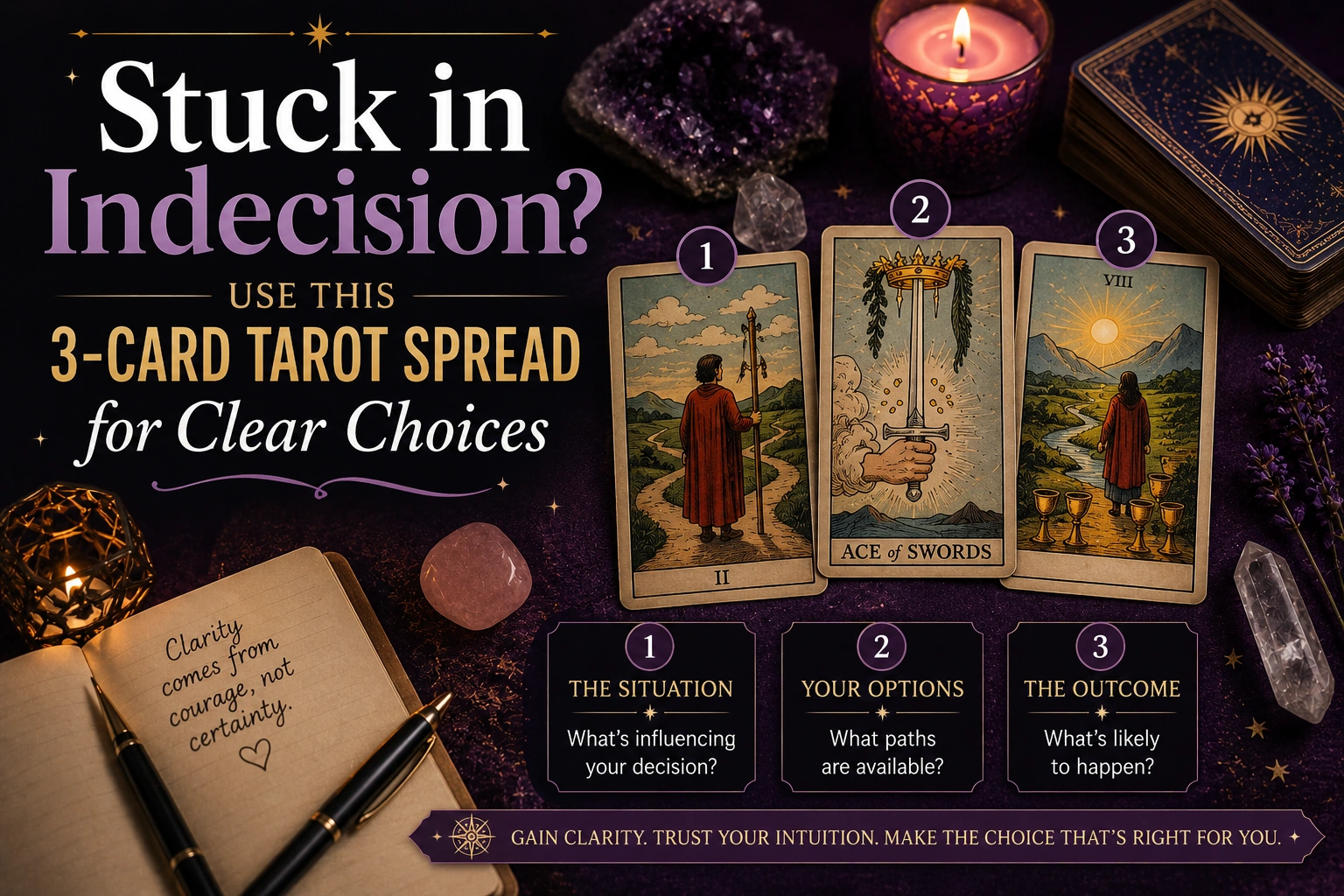
Tarot for Decision Making: A 3-Card Spread for Clear Choices
This is the simplest and most effective decision-making spread for most situations. Three cards, three focused questions, a complete picture of where you are and where to go.
Card 1: What Is the Real Issue Behind This Decision?
The first card cuts through the surface-level question to the underlying conflict. Most of the time, what we think a decision is about is not quite what it’s actually about.
A choice that appears to be about a job is often about security versus purpose. A choice that appears to be about a relationship is often about self-worth versus fear of loneliness.
This card names the actual issue driving the indecision — the real tension you’re trying to resolve. Pay close attention to the suit: Cups indicate the core issue is emotional; Swords suggest it’s about fear, belief, or mental pattern; Pentacles point to material or practical concerns; Wands name a question of passion, direction, or energy.
Major Arcana here signals something of deep personal significance.
Card 2: What Do I Need to Understand Before Choosing?
The second card names what you’re missing, minimizing, or avoiding in your current understanding of the situation. This is the blind spot card — and it is often the most valuable position in the spread.
The Two of Swords here says you’re actively avoiding looking at something important. The Seven of Cups says you’re letting fantasy or wishful thinking distort your view of the options.
Justice says a fair, honest assessment of the situation is what’s missing and what would resolve everything. The Moon says there’s hidden information — something not yet visible that would change your reading of the situation if you could see it.
Whatever appears here, give it real, honest attention. The resistance this card triggers is almost always a sign that it’s pointing at exactly what you need.
Card 3: What Is the Wisest Next Step?
The third card doesn’t necessarily tell you which option to choose. It tells you the most aligned, wise, and responsible action available to you right now — which might be gathering more information, having a specific conversation, waiting until a particular condition is met, or taking one concrete step toward one of the options.
The Hermit here says spend time alone with this before making any move. The Chariot says you already have what you need — move forward with decisive commitment.
The Ace of Swords says bring full honesty and clarity to the conversation or situation that the decision involves. Temperance says neither option requires a dramatic leap — the wisest step is a measured, thoughtful, gradual movement.
Whatever card arrives in this position, translate it into the most specific, concrete action possible. That action is your homework from the reading.
How to Use This 3-Card Tarot Spread
The quality of a decision-making reading is largely determined by the state you’re in when you do it and the clarity with which you’ve defined the question. These six steps maximize both.
Step 1: Define the Decision Clearly
Write the decision down in one or two plain, honest sentences before touching the cards. “Should I accept the job offer in Denver or stay at my current job in Chicago?” is a clear decision.
“I don’t know what to do with my life” is too broad for a useful spread. The more specifically you define the choice, the more specifically the cards can address it.
If you can’t write the decision clearly, spend five minutes doing that before you begin — the clarity this creates is often illuminating before a single card is pulled.
Step 2: Avoid Asking From Panic or Pressure
Decision-making readings done in the grip of acute anxiety, urgency, or emotional overwhelm are consistently less useful than those done from even a slightly more grounded state. If you’re in crisis mode right now — heart racing, catastrophic thoughts running — take five minutes to breathe before you begin.
Go for a short walk. Drink a glass of water.
Even a brief interruption of the panic state will improve your ability to both shuffle with genuine intention and interpret what the cards actually say rather than what your anxiety wants them to say.
Step 3: Shuffle With One Focused Question
Hold your clearly defined decision in mind — not as an anxious demand, but as an open, genuine inquiry. Shuffle until the shuffling feels complete (most readers use an intuitive sense of “readiness” rather than a fixed number).
If a card falls out during shuffling, set it aside — it often carries significant additional guidance and can be read as a fourth message from the deck.
Step 4: Pull Three Cards Slowly
Draw one card at a time and place each in its designated position before pulling the next. Don’t look at all three and then arrange them — the order in which you pull matters to how the narrative reads.
Place Card 1 (the real issue), Card 2 (what you’re missing), and Card 3 (the wisest next step) in a simple left-to-right line in front of you.
Step 5: Read the Cards as a Story
Before interpreting each card in isolation, step back and read the three cards as a complete narrative. What is the story they’re telling together?
Does the story confirm something you already suspected? Does it challenge the framing of the decision in some way?
Are there patterns across the three cards — multiple Swords suggesting a decision that’s primarily about thought patterns and fear, multiple Cups suggesting the emotional dimension is most important? The full story of the spread is often more illuminating than any single card.
Step 6: Journal the Message Before Acting
Write down what the reading showed you — in plain, practical language, not symbolic tarot-speak. Not “The Three of Swords appeared in position two” but “The reading suggested I’m avoiding acknowledging how much pain the current situation is already causing me, and that acknowledgment is what’s actually missing from my decision-making.”
Write your interpretation, your emotional response to it, and the one specific action it’s pointing toward. Then step away for twenty-four hours before acting.
The distance will help you distinguish between the reading’s actual guidance and the interpretation colored by whichever option you were already leaning toward.
Best Tarot Questions for Decision Making
The question shapes the reading. These seven questions consistently produce the most honest and actionable guidance in decision-making tarot sessions.
What Am I Not Seeing Clearly About This Choice?
The most immediately useful decision-making question, because it explicitly asks for the blind spot. Whatever card appears in response to this question is naming the dimension of the situation you’ve been filtering out — either because it’s uncomfortable, because it challenges a preferred narrative, or simply because it hasn’t yet come into conscious focus.
The card that appears here often shifts the entire frame of the decision.
What Fear Is Influencing My Decision?
This question separates genuine intuition from anxiety. Fear often masquerades as practicality, caution, or wisdom — making it easy to mistake anxious avoidance for thoughtful deliberation.
When you ask explicitly about the fear that’s active in this decision, the card that appears names it directly: fear of failure (Five of Pentacles), fear of change (Four of Pentacles), fear of being wrong (Eight of Swords), fear of loss (Three of Cups reversed), or fear of stepping into one’s full power (Strength reversed). Naming the fear doesn’t eliminate it — but it does make it impossible to continue pretending it’s something more rational.
What Does My Intuition Already Know?
This question bypasses the analytical layer and goes directly to the deeper intelligence. It asks: what does the quiet, clear part of you — the part that’s been patiently waiting while the anxious mind spins — already know about this situation?
The High Priestess, The Hermit, the Ace of Swords, and Major Arcana cards in general tend to appear here with particular resonance. Read this card with your gut response first, before consulting any reference.
What Is the Practical Reality of Each Option?
This question grounds the reading in the material world rather than the emotional or intuitive realm. Pentacles cards are particularly significant here — they name the actual financial, logistical, or physical reality of the options in ways that the emotional layer of the decision can obscure.
If you’ve been doing a lot of emotionally-based exploration of the choice, this question provides necessary ballast.
What Choice Supports My Long-Term Growth?
This question takes the decision out of the immediate context and places it in the larger frame of your personal evolution. Sometimes the answer differs significantly from what feels most comfortable or desirable right now.
Strength, The World, The Tower, Judgment, and other transformation-associated cards frequently appear in response to this question when the choice with the most growth potential is also the most challenging one.
What Consequence Should I Prepare For?
This honest, practical question asks the reading to name not just what you should do, but what you should expect if you do it. It’s not asking for reassurance — it’s asking for real information about what comes next so you can prepare wisely rather than acting naively.
Whatever card appears here is a preparation message: this is what’s coming, and this is what you’ll need to navigate it well.
What Is the Next Honest Step?
The most actionable of the seven questions — and the one that most effectively bridges the gap between reading and real-world decision. Not “what should I ultimately do” but “what is the most honest, responsible, aligned step available to me right now.”
This question tends to produce specific, concrete guidance that can be acted on in the next twenty-four to forty-eight hours, which is exactly what most decision-making situations need.
Tarot Spread for Choosing Between Two Options
When you’re weighing two specific options against each other, this 6-card spread gives you a comparative view of both paths alongside the guidance you need to choose wisely.
Card 1: The Energy of Option A
This card describes the essential quality or energy of the first option — not whether it’s good or bad, but what it fundamentally is and what it would feel like to move in this direction. Read the suit, the imagery, and your emotional response to the card together for the fullest picture.
Card 2: The Energy of Option B
The same question applied to the second option. Compare Cards 1 and 2 carefully — the contrast between them often illuminates the choice more clearly than either card does alone.
Which energy feels more aligned with who you genuinely are and what you genuinely need right now?
Card 3: What I Need to Know Before Deciding
This middle card holds the most important piece of information for making a wise choice between the two options — the factor you may be underweighting, the truth neither option’s energy card fully revealed, or the personal quality the decision is asking you to develop regardless of which path you take.
Card 4: The Likely Outcome of Option A
This card names the probable trajectory if you choose Option A — not a fixed guarantee, but the energetic direction this path leads. Read it in combination with Card 1: does the outcome align with the energy you sensed at the beginning, or does it suggest a path that starts one way and leads somewhere significantly different?
Card 5: The Likely Outcome of Option B
The same directional view for Option B. Compare Cards 4 and 5 together to get a sense of where each path leads.
Also compare both outcome cards with what you identified in Cards 1 and 2 as the energies of each option. Do the outcomes make sense given the initial energies?
What does the trajectory of each path tell you about its fit with your current values and long-term direction?
Card 6: The Guidance My Higher Self Needs Now
This final card steps back from the specific comparison and offers the most personally relevant message from your own deeper wisdom — the thing that matters most, regardless of which option you choose. Frequently the most important card in the spread.
It often names a quality of approach (patience, honesty, courage, trust) that will serve you well on either path, or names the one thing that’s most essential for you to bring to this moment of decision.
Tarot Cards That Suggest Clarity and Wise Choices
These seven cards appear most frequently in decision-making readings when genuine clarity, wise direction, and good timing are present.
Justice: Truth, Fairness, and Accountability
Justice in a decision-making reading says the clearest path forward involves an honest, fair-minded assessment of the situation — free of wishful thinking, rationalization, or the distortion of wanting a particular answer. When Justice appears, it is asking: if you set aside preference and looked at this situation as it actually is, what would you see?
The answer to that question is usually the decision.
The Hermit: Reflection, Wisdom, and Inner Guidance
The Hermit says the clarity you’re seeking is not going to arrive from more external input — more conversations, more research, more opinions from friends. It’s already present in your own inner knowing, waiting for the quiet and solitude to become audible.
When The Hermit appears in a decision spread, the wisest move is to create space for genuine reflection before making any external move.
The Chariot: Direction, Willpower, and Commitment
The Chariot signals that the time for reflection has passed — you have enough information, and the choice requires decisive commitment rather than more deliberation. When this card appears, continued delay is itself a choice, and not usually a wise one.
The Chariot asks you to pick a direction and drive.
Temperance: Patience, Balance, and Moderation
Temperance in a decision spread often carries the message that the wisest choice is not the dramatic one. It suggests a middle path, a blended approach, or a gradual movement rather than an all-or-nothing leap.
When Temperance appears, ask: is there a way to honor both what you want from each option, rather than treating this as a binary either-or?
The High Priestess: Intuition and Inner Knowing
The High Priestess says your intuition already knows. You don’t need more information, more analysis, or more time.
You need to go quiet enough to hear what you already sense. When she appears in a decision reading, the decision that feels most right in your body — beneath the noise of anxious thinking — is almost always the right one.
Two of Wands: Planning and Future Vision
The Two of Wands in a decision reading signals that this is a moment for strategic planning and forward-looking vision rather than reactive decision-making. It asks you to hold the bigger picture: which option aligns with where you genuinely want to be in five years, not just where you want to be next month?
Ace of Swords: Truth, Insight, and Mental Clarity
The Ace of Swords is the breakthrough card of the tarot — the moment when confusion suddenly resolves into clear, piercing understanding. When this card appears in a decision spread, it often signals that the clarity you need is available right now if you’re willing to be completely honest with yourself about what you see.
Cut through the noise. What’s actually true here?
Tarot Cards That Reveal Indecision or Confusion
These five cards are the decision-making spread’s most honest mirrors — they appear when something specific is keeping the choice frozen, and they name it directly.
Two of Swords: Avoidance and Blocked Clarity
The blindfolded figure of the Two of Swords is one of the tarot’s most direct images of deliberate avoidance. In a decision spread, this card says: you are actively choosing not to look at something important.
The balance of the two swords represents a stalemate that is being maintained through willful not-seeing. The question this card asks is simple and uncomfortable: what are you refusing to look at?
Look at it. The decision will follow.
Seven of Cups: Too Many Options or Fantasy Thinking
The Seven of Cups appears when the decision has become distorted by wishful thinking, unrealistic expectations, or the overwhelming proliferation of options (including options that are more fantasy than genuine possibility). In a decision reading, this card calls for a reality check: of the options you’re considering, which ones are genuinely real and viable, and which ones are you holding onto because they feel safer than committing to something concrete?
The Moon: Uncertainty, Fear, and Hidden Information
The Moon in a decision spread says that not everything relevant to this choice is currently visible. There may be information still to emerge, an important conversation not yet had, or a dimension of the situation still operating beneath the surface of what you can currently see.
When The Moon appears, it’s usually not time to decide — it’s time to wait for more light.
Eight of Swords: Feeling Trapped by Your Own Thoughts
The Eight of Swords is the tarot’s image of self-imposed limitation — the figure bound and blindfolded, surrounded by swords that form no actual barrier. In a decision reading, this card says the primary obstacle to clarity is inside your own head.
The catastrophic thinking, the “I have no good options” narrative, the belief that you’re more stuck than you actually are — these are the swords. They are your own mind.
And — critically — you can take the blindfold off and walk out.
Hanged Man: Pause, Delay, and New Perspective
The Hanged Man in a decision reading often arrives as an invitation rather than a frustration: not yet. This isn’t the right moment for this decision.
Suspend it deliberately — not through avoidance but through genuine, patient willingness to let a new perspective develop. The Hanged Man frequently appears when a choice that seems impossible from the current vantage point will become clear once the viewpoint has fundamentally shifted.
Tarot Cards That Suggest You Should Wait Before Deciding
Not every decision reading ends with “act now.” These five cards carry a consistent message of wise patience.
Four of Swords: Rest Before Action
The Four of Swords prescribes deliberate rest and withdrawal before any decision is made. This card often appears when the person has been in decision-making mode for so long that their judgment is compromised by exhaustion.
The most productive thing you can do right now is not decide — it’s rest, and return to the question when you’re genuinely recovered.
Hanged Man: Surrender and Perspective
As noted above, The Hanged Man asks for a fundamental shift in perspective before action. The decision that’s impossible from where you’re currently standing will become clear from a different angle.
Surrender the urgency and allow that shift to occur naturally.
Temperance: Patience and Timing
Temperance as a waiting card says that the right conditions for this decision have not fully formed. Move slowly.
Allow the situation to develop. The right moment will be unmistakable — and acting before it arrives will produce a less aligned outcome than waiting for it.
High Priestess: More Information Is Hidden
The High Priestess as a waiting card says that relevant information is still concealed — either by the situation, by another person, or by aspects of your own unconscious that haven’t yet surfaced into clarity. Trust what you know, but also trust that there’s more to know.
Wait until more comes to light before committing.
Seven of Pentacles: Evaluate Before Investing Further
The Seven of Pentacles depicts a figure pausing in front of their growing crop — evaluating the results of what has already been invested before deciding whether to continue. In a decision reading, this card asks you to honestly assess the return on what you’ve already put in before deciding to invest further.
Sometimes the wisest decision is recognizing that what you’re evaluating hasn’t proven itself yet and patience is the appropriate response.
Tarot Cards That Suggest It Is Time to Act
And when the time for waiting is over, these five cards say it clearly.
The Chariot: Move Forward With Discipline
When The Chariot appears, the analysis phase is done. What’s required now is disciplined commitment to a chosen direction.
Stop looking for more certainty — it isn’t coming. Choose and move with focus.
Ace of Wands: Act on Inspiration
The Ace of Wands brings a surge of creative energy and inspired possibility that has a specific window. When this card appears in a decision reading, act while the energy is alive.
Inspired timing matters; hesitation risks letting the moment pass.
Knight of Swords: Make the Move, but Avoid Impulsiveness
The Knight of Swords says move quickly and decisively — but with his characteristic caveat: make sure you’ve thought it through before you charge. This isn’t a card of recklessness.
It’s a card of prepared, committed action. Do your final due diligence and then go, without further second-guessing.
Eight of Wands: Momentum and Fast Progress
The Eight of Wands signals that conditions are currently aligned for fast, clear forward movement. This isn’t a moment to deliberate — it’s a moment to act while the wind is with you.
What’s been stuck may move very quickly once you commit.
The Magician: Use Your Resources and Take Initiative
The Magician says you have everything you need to make this decision and act on it well. All four suits are on the table before him — you have the emotional, intellectual, material, and creative resources required.
The only thing missing is the decision to use them. That decision belongs to you.
Decision Making Tarot Reading Examples
These five brief examples show how tarot for decision making plays out across different real-world scenarios.
Example 1: Choosing Whether to Leave a Job
3-card draw: Ten of Wands (real issue), Two of Swords (what’s missing), The Fool (wisest next step). The reading tells a clear story: the real issue isn’t just dissatisfaction — it’s exhaustion.
The person has been overloaded for so long they’re making the decision from depletion rather than clarity. What’s missing is the willingness to honestly acknowledge how burned out they are.
The wisest next step isn’t to quit tomorrow — it’s to take a genuine break, recover enough to think clearly, and then assess from a place of genuine rest rather than desperation. The Fool doesn’t say stay or go.
It says: approach whatever comes next with openness rather than making a panicked leap.
Example 2: Deciding Whether to Continue a Relationship
3-card draw: Three of Swords (real issue), The Moon (what’s missing), The Hermit (wisest next step). This reading names the unspoken: there has been genuine heartbreak in this relationship that hasn’t been honestly acknowledged or addressed.
The Moon says there is still information that isn’t fully visible — possibly about the other person’s true feelings or intentions, or about the reader’s own real needs beneath the surface. The Hermit prescribes time alone — not to make the decision, but to hear their own truth without the noise of the relationship itself obscuring it.
The answer will come from solitude, not from more conversations with the other person.
Example 3: Choosing Between Two Opportunities
6-card draw: Ace of Pentacles / Eight of Wands / Justice / Seven of Pentacles / The World / The Star. Option A carries new financial opportunity energy; Option B carries fast momentum and excitement.
What’s needed is honest assessment (Justice). Option A’s outcome is slow but solid evaluation of the investment.
Option B’s outcome is genuine mastery and long-term completion — significant growth. The higher self’s guidance is hope and alignment: choose the direction that feels genuinely aligned, not just exciting.
The reading is gently pointing toward Option B’s long-term potential, while Justice asks for a clear-eyed honest look at Option A’s slower reality.
Example 4: Deciding Whether to Move to a New City
3-card draw: Four of Cups (real issue), The Tower (what’s missing), Six of Swords (wisest next step). The real issue isn’t about the new city — it’s about emotional boredom and stagnation in the current situation that has been quietly building.
What’s missing is the honest acknowledgment that what the person is trying to leave isn’t just the city, but the person they’ve been being in it. The Tower says the disruption is necessary regardless of the logistics of the move — some structure needs to come down.
Six of Swords confirms: movement is genuinely supported. This change leads to calmer waters.
The wisest next step is to begin the practical planning of the move.
Example 5: Knowing Whether to Act Now or Wait
3-card draw: Knight of Cups (real issue), Four of Swords (what’s missing), Temperance (wisest next step). The real issue is romantic in origin — the decision is being driven by emotion and longing more than practical assessment.
What’s missing is rest — the person has been in reactive mode and hasn’t had the quiet to hear their own deeper wisdom. Temperance as the wisest next step says neither act impulsively nor wait indefinitely.
The best move is a deliberate, measured approach: slow down, rest, and allow the emotional intensity to settle enough that the choice emerges from genuine wisdom rather than from the heat of feeling.
How to Read Tarot Without Giving Away Your Power
The most important skill in tarot for decision making is keeping the power of the choice exactly where it belongs: with you.
Tarot Should Clarify, Not Control
A tarot reading is a reflective tool, not an authority. The cards offer perspective, surface what’s hidden, and name what’s being avoided.
They do not — and should not — make your choices for you. If you find yourself feeling like you must follow what the cards said regardless of your own judgment, you’ve crossed the line from using tarot as a tool into using it as an escape from personal responsibility.
Always ask: what does this reading help me see? Not: what does this reading tell me to do?
Why Yes-or-No Questions Can Limit Insight
“Should I take this job: yes or no?” is a much less useful question than “What do I need to understand about this job offer?” or “What is the wisest next step regarding this opportunity?” Yes-or-no questions produce binary answers that strip away all the nuance — the emotional truth, the underlying fears, the practical reality — that actually makes a decision wise.
Open questions consistently produce richer, more actionable guidance.
How to Combine Intuition With Practical Facts
Tarot illuminates the intuitive and emotional dimensions of a decision. The practical dimensions still require practical research.
Use the reading to understand what you want, what you fear, and what your deeper wisdom knows — then verify the practical facts: financial implications, logistical realities, actual market conditions, legal considerations. Both layers are necessary.
Neither is sufficient alone.
When to Ask for Real-World Advice Too
Tarot for decision making is powerful for the internal, intuitive dimensions of a choice. For the external, practical dimensions — financial planning, legal decisions, medical choices, career transitions requiring specific expertise — get real-world professional advice alongside your reading.
Tarot and professional consultation are not in competition. They address different layers of the same decision, and both are more useful together than either is alone.
How to Turn a Reading Into One Responsible Action
Every decision-making tarot reading should end with one specific, concrete, responsible next step. Not a final decision (which may still require more time, information, or professional input) but one real thing you will do within the next twenty-four to forty-eight hours based on what the reading showed you.
Write it down. Keep the commitment.
This is how tarot becomes genuinely useful rather than endlessly interesting.
Common Mistakes When Using Tarot for Decisions
Even experienced readers fall into these patterns. Knowing them in advance helps you avoid them.
Asking the Same Question Repeatedly
This is the most common mistake in decision-making readings: pulling cards on the same question until you receive the answer you were hoping for. The first card pulled from a genuine, open, grounded state is almost always the most accurate.
Every subsequent pull in search of a different answer is a search for permission rather than clarity — and the cards, if you’re willing to be honest, will often keep showing you versions of the same thing.
Pulling Too Many Clarifying Cards
One clarifying card per reading session is usually appropriate. Three or more “clarifiers” on a single confusing card is avoidance — the original card’s discomfort being bypassed through more cards rather than through honest engagement with what it’s actually saying.
When a card makes you uncomfortable, sit with the discomfort before reaching for another.
Reading Only the Answer You Want
This happens when you interpret cards selectively — unconsciously emphasizing the aspects that support your preferred option while downplaying or explaining away what challenges it. One useful guard: after any reading, ask yourself honestly whether you’ve interpreted each card with the same rigorous honesty, or whether you’ve been more generous with the cards that confirmed what you wanted to do.
If the answer is the latter, re-read the challenging cards more carefully.
Ignoring Practical Consequences
Tarot for decision making is one layer of a complete decision-making process. It illuminates the emotional and intuitive dimensions beautifully.
It does not replace the practical financial analysis, the professional consultation, the research into actual conditions and consequences that any significant decision deserves. A card that says “take the leap” does not mean “take the leap without practical preparation.”
Confusing Anxiety With Intuition
Anxiety and intuition can feel similar — both arrive as strong inner signals about a choice. But they have different qualities.
Intuition tends to feel quiet, clear, and consistent over time. Anxiety tends to feel urgent, shifting, and dependent on external circumstances for its intensity.
In a decision reading, the most anxious interpretation of a card is rarely the most accurate one. If your reading is making you more anxious rather than clearer, a grounding practice before re-reading is more useful than more cards.
Expecting Tarot to Remove All Uncertainty
No reading — tarot or otherwise — will eliminate all uncertainty from a significant decision. Life is uncertain.
The future is genuinely unknown. What tarot can do is clarify the most aligned direction and help you make the wisest possible choice with the information currently available.
Learning to move forward with some remaining uncertainty is not a failure of the reading. It is the nature of living decisively.
How to Journal After a Decision Tarot Reading
These five prompts complete the reading by translating its insights into genuine self-knowledge and practical clarity.
What Choice Am I Actually Afraid to Make?
Write honestly about the specific fear underneath the indecision. Not the practical concern — the deep fear.
Fear of being wrong. Fear of loss.
Fear of commitment. Fear of disappointing someone.
Naming it specifically makes it possible to address it rather than be unconsciously governed by it.
What Did the Cards Confirm That I Already Felt?
Write about the moment of recognition in the reading — the card or interpretation that landed as immediately, unmistakably true. This is the part of yourself that already knew.
Acknowledge it. The fact that you already knew this is important information.
What Practical Fact Do I Need to Consider?
Write about the one external, material, or practical fact that is most relevant to this decision that the reading has brought into sharper focus. What do you need to research, verify, discuss, or plan for that you may have been avoiding?
What Would I Choose If I Trusted Myself More?
Answer this question honestly — without justification, without hedging, without immediately listing all the reasons it might not work. Just: what would you choose if you trusted yourself?
This answer is often the clearest signal in the entire journaling session.
What Is One Small Step I Can Take Today?
Write down one specific, small, concrete, responsible action that moves you in the direction the reading pointed — something you can do in the next twenty-four hours. Not the final decision.
One step toward clarity or toward the choice. Take it.
Let the next step reveal itself from there.
Final Thoughts on Tarot for Decision Making
The hardest part of any significant decision is rarely the lack of information. It’s the gap between what you know and what you’re willing to clearly see — the fear operating beneath the intellectual analysis, the value you haven’t admitted to yourself, the quiet knowing that’s been patiently waiting for you to stop spinning long enough to hear it.
Tarot for decision making works because it addresses that gap directly. It gives the emotional truth a form.
It makes the avoidance visible. It names the fear.
It points toward the wiser next step. And in doing all of that, it gives you what the endless mental loop of pros-and-cons analysis almost never provides: genuine clarity about what you actually know, what you actually want, and what you’re actually afraid of.
The 3-card spread in this guide is simple enough to use tonight and powerful enough to shift how you see a decision you’ve been circling for months. The 6-card comparison spread gives you a complete, honest view of two competing paths.
The best questions in this guide give you exactly the right angles to approach any choice that matters. And the journaling prompts translate everything into one honest, responsible, concrete next step.
Tarot does not choose your life for you. That responsibility — and that privilege — belongs entirely to you.
What it does is make it genuinely harder to keep avoiding what you already sense, easier to hear your own truth clearly, and more possible to move forward from that truth with confidence. Not certainty — you rarely get certainty.
But confidence. The kind that comes from making a choice from genuine self-knowledge, honest acknowledgment of the stakes, and the quiet courage of deciding to trust yourself.
Pick up the cards. Ask the honest question.
Take one step. And then take the next.