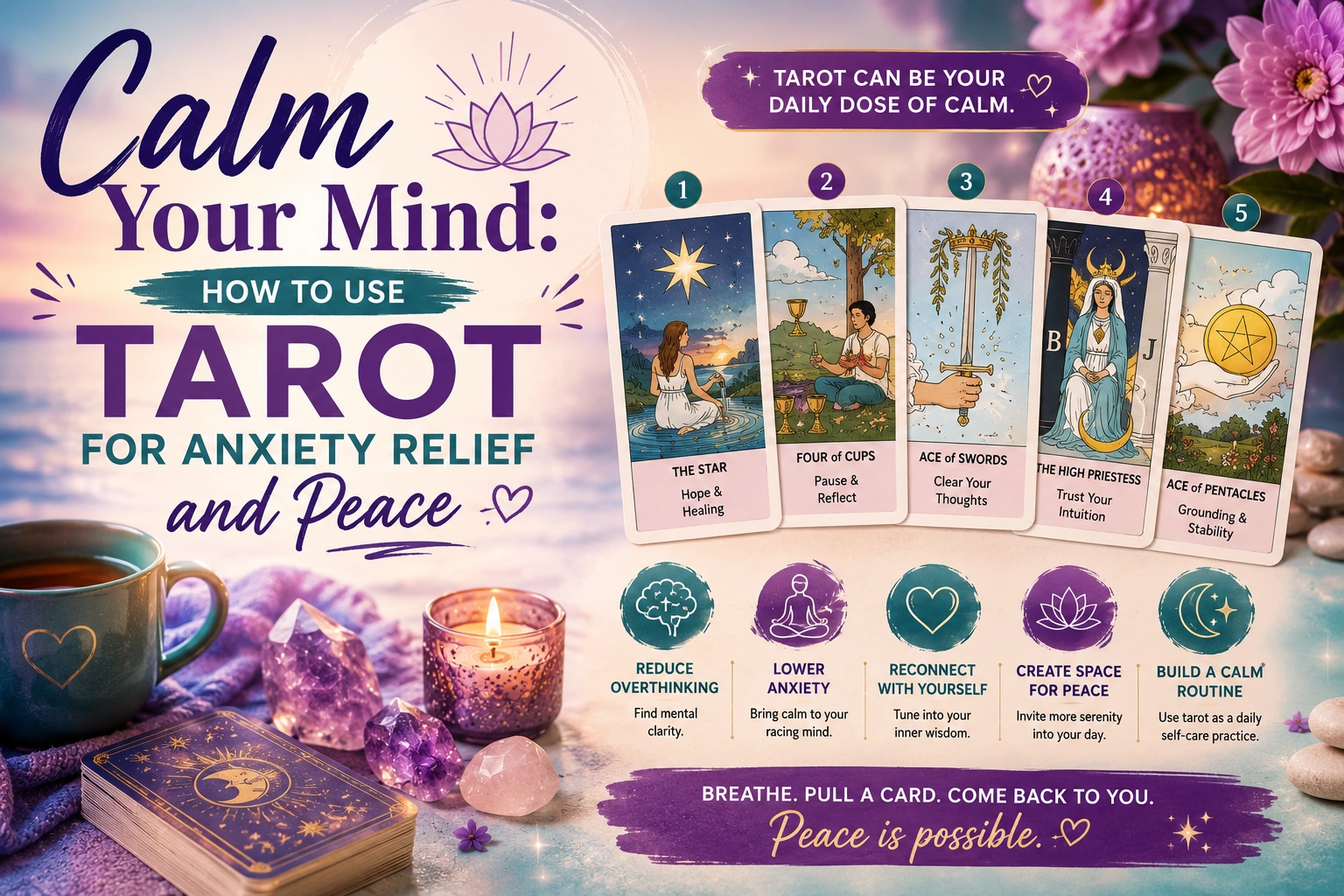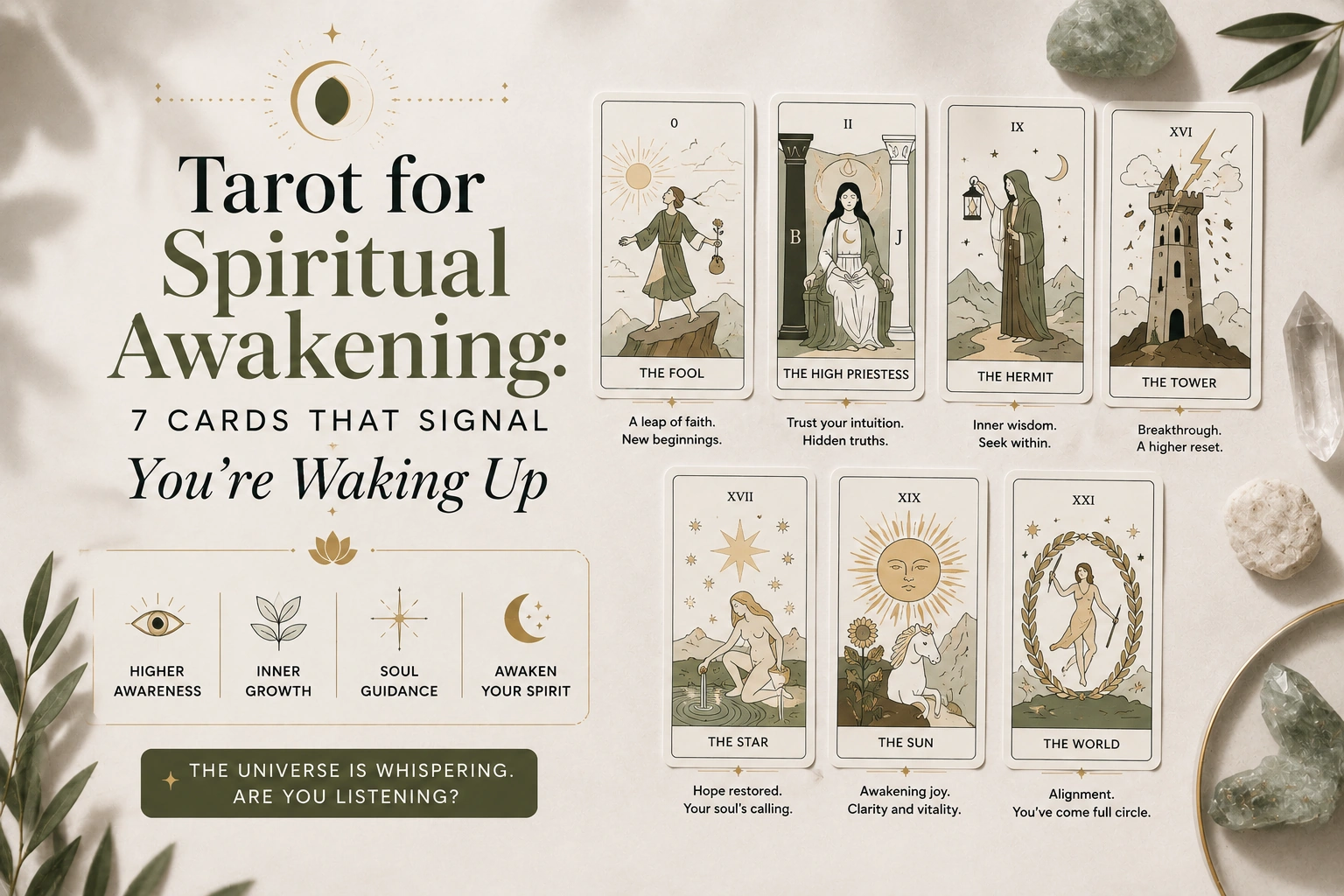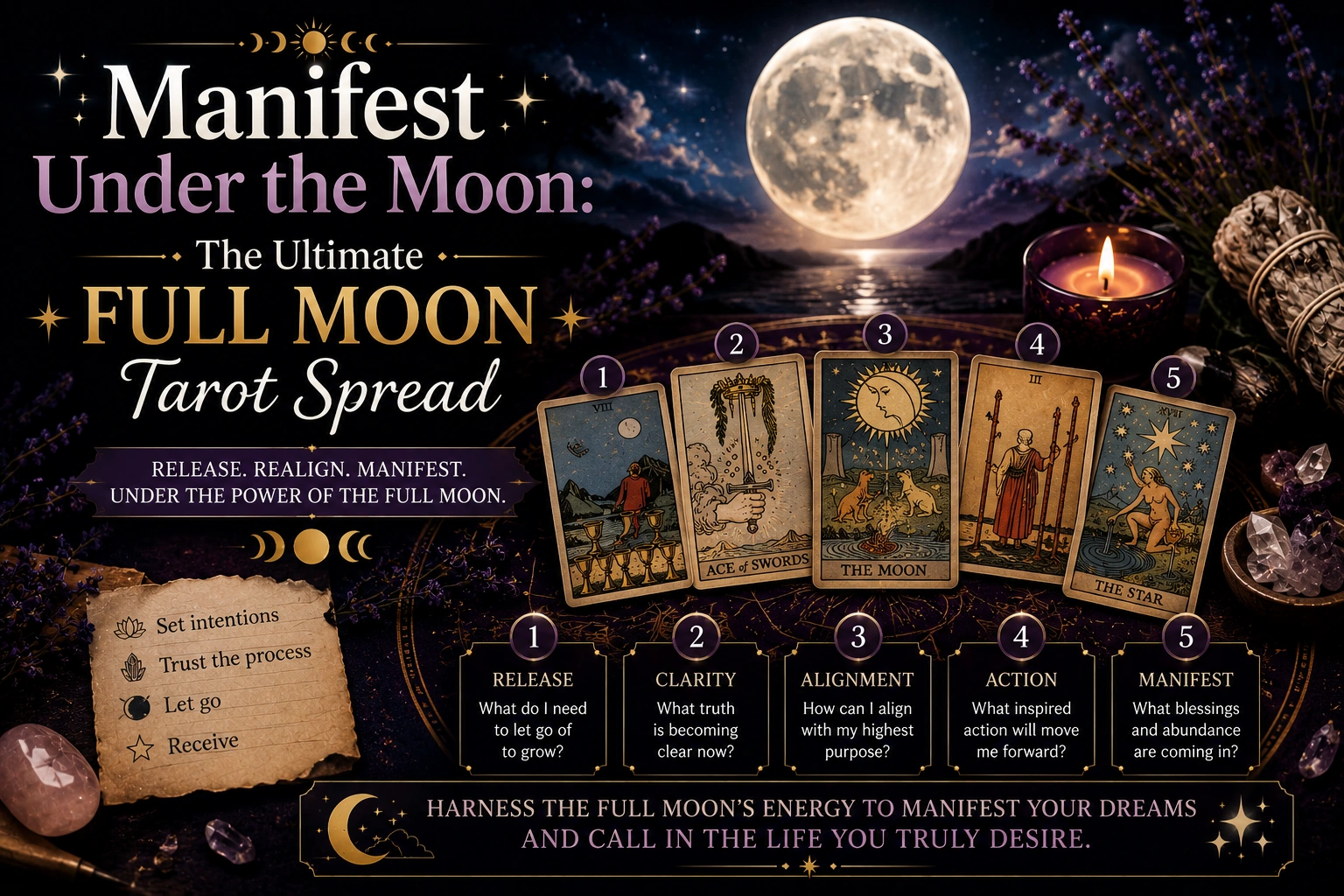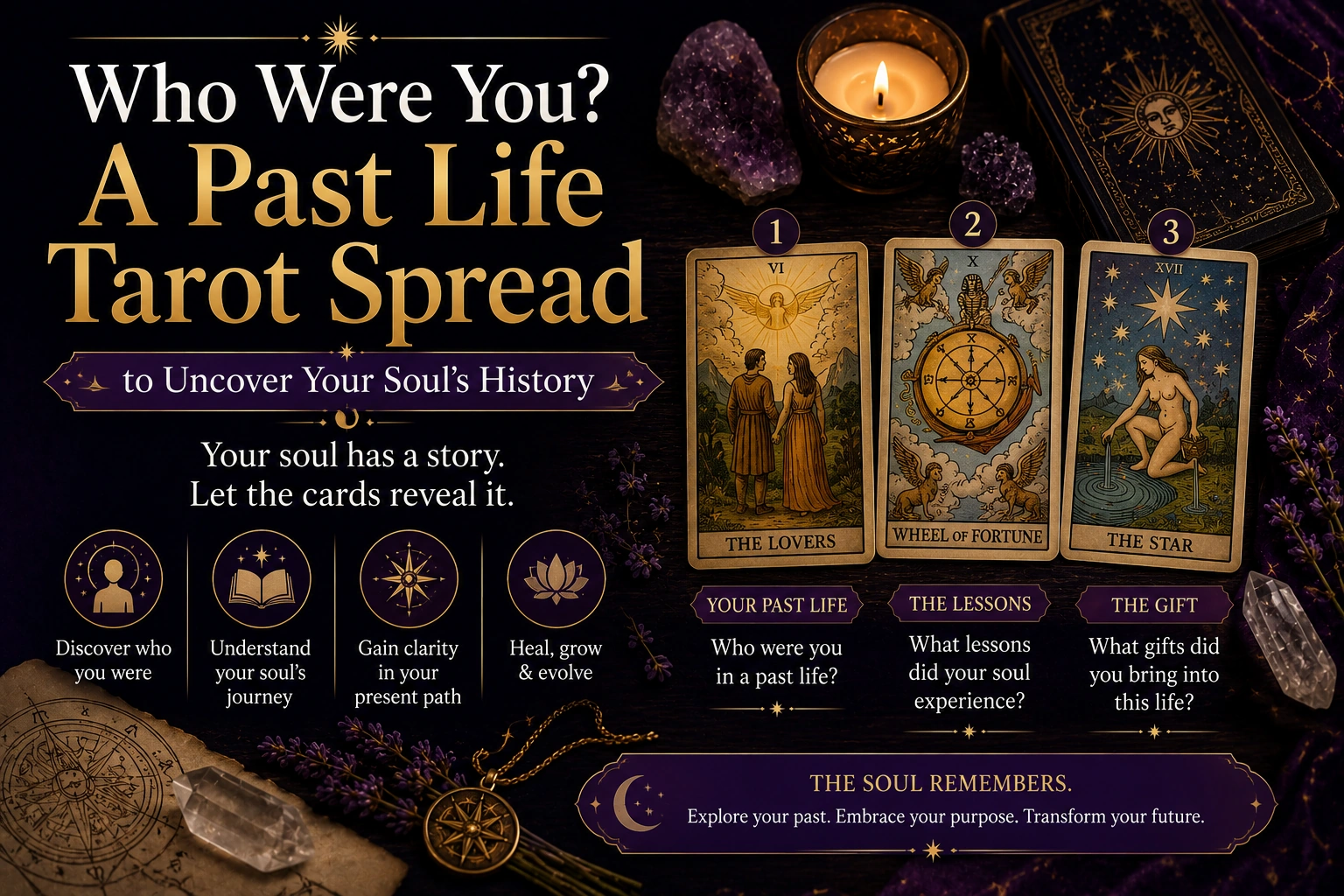
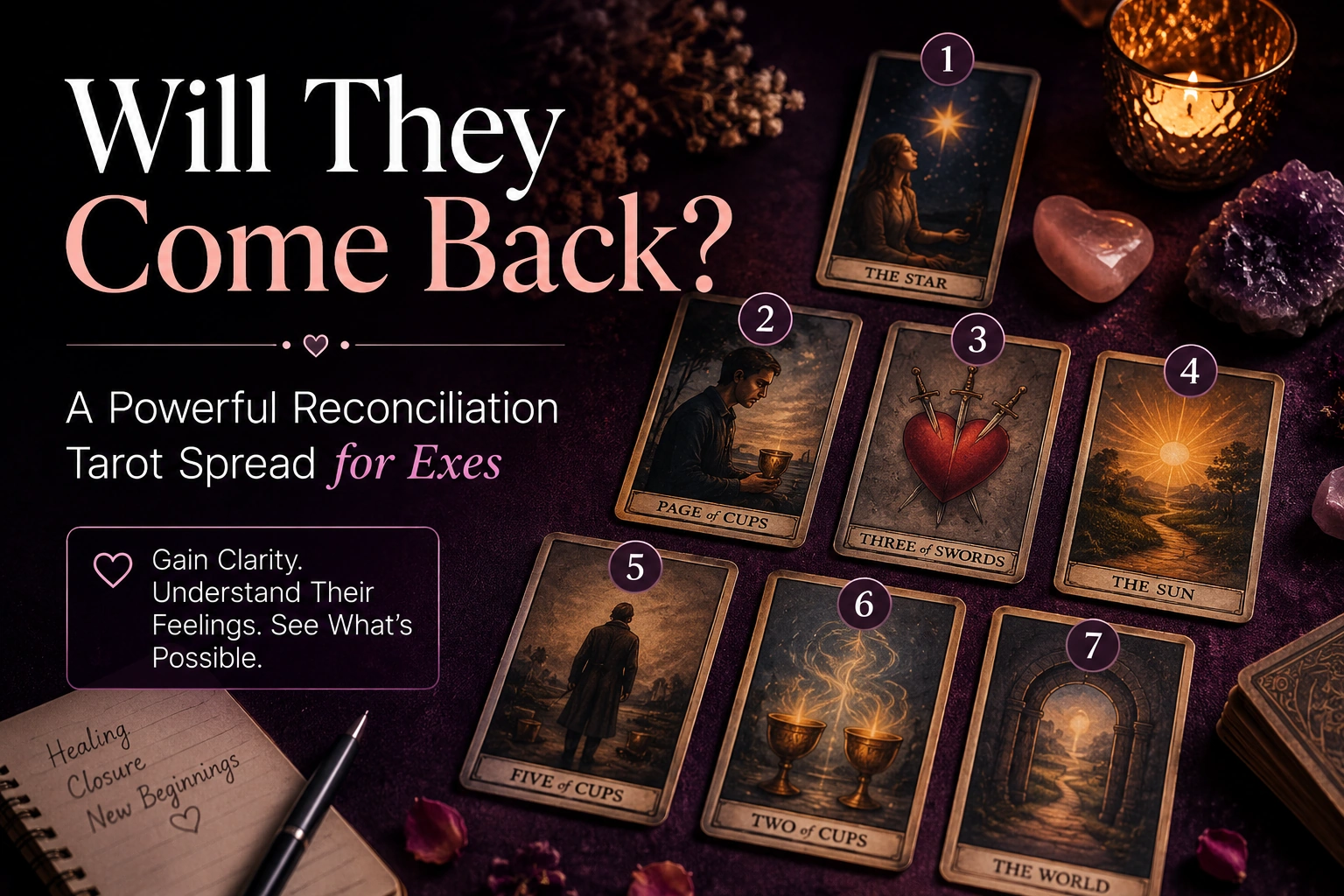
There’s a particular kind of wondering that comes after a relationship ends — the kind that finds you checking your phone at 2 a.m., replaying conversations, noticing how certain songs still feel like they belong to someone else.
The wondering is: do they miss me?
Are they thinking about this too? Could there be a second chance?
That’s exactly the territory a reconciliation tarot spread is designed to help you navigate.
Not by telling you what to feel, or by pretending to know exactly what’s happening in another person’s heart, but by illuminating the energetic truth of the situation — what still exists between you, what’s been left unresolved, what would need to change, and whether a second chapter together is genuinely possible or whether what’s calling you is healing, not return.
This guide gives you a complete 8-card reconciliation tarot spread, detailed card interpretations, real reading examples, and the kind of honest, grounded perspective that helps you use tarot for love clarity without losing yourself in hope that isn’t anchored to reality.
Before we begin: tarot is a powerful tool for emotional reflection and spiritual insight. It cannot guarantee another person’s actions, feelings, or choices.
It cannot tell you to wait indefinitely.
And it should never be used to override your own intuition, your self-respect, or the practical wisdom that tells you when something — or someone — is not actually good for you.
What Is a Reconciliation Tarot Spread?
A reconciliation tarot spread is a structured tarot reading specifically designed to explore the energetic and emotional landscape of a relationship after it has ended — asking not just whether reunion is possible, but whether it would be healthy, and what would have to be true for it to work.
The Purpose of a Reconciliation Tarot Reading
The reconciliation tarot reading serves several distinct purposes, and understanding all of them makes the spread more useful. Yes, it can explore whether an ex may return.
But it also illuminates what emotional energy still exists on both sides, what unresolved pain or pattern is keeping the two people apart, what personal growth would need to happen before a second chance could be genuinely different from the first time, and whether reunion or closure is the more healing path forward.
Used well, a reconciliation tarot spread doesn’t just answer the will-they-come-back question. It helps you understand the full emotional truth of where things stand — including the parts of that truth that are uncomfortable but important.
What Tarot Can and Cannot Tell You About an Ex
Here is the honest version of this: tarot can reveal emotional energy, archetypal patterns, and the directional pull of current circumstances.
It is remarkably good at naming what feels true beneath the surface of a situation — the unspoken feelings, the unresolved tensions, the energetic thread that still runs between two people who haven’t fully released each other.
What tarot cannot do is read another person’s mind with certainty, override their free will, or guarantee a specific outcome.
A card that suggests your ex still carries feelings doesn’t mean they’ll act on those feelings. A card that suggests a positive emotional energy doesn’t mean reconciliation will happen without both people choosing it consciously and honestly.
Keep this distinction present throughout the reading. The cards speak in probabilities and energies, not certainties.
Why Reconciliation Requires More Than Feelings
This is perhaps the most important principle in any reconciliation tarot reading: feelings, even strong ones, are not sufficient for healthy reconciliation.
What feelings tell you is that something significant happened between two people — something worth taking seriously. What they don’t tell you is whether the conditions, the growth, and the accountability are in place to make a second attempt genuinely different.
A reconciliation tarot spread is most useful when it examines not just the emotional dimension of the question, but also the practical and relational one: what actually broke down, what would need to be repaired, and whether both people are capable of doing that repair.
Reconciliation Tarot Spread: Will They Come Back?
This 8-card reconciliation tarot spread covers the full emotional landscape of a potential reunion — the energy between you, their inner state, what’s blocking the path, what needs healing, whether contact is likely, and what the ultimate outcome might hold. Lay the cards in two rows of four, or in a single horizontal line, whichever feels most natural.
Card 1: What Is the Current Energy Between Us?
This foundational card names the energetic truth of the connection as it currently stands — not how you wish it were or fear it might be, but what is actually alive between you right now.
A card like the Two of Cups or Six of Cups signals that genuine warmth and emotional connection are still present.
The Eight of Cups suggests movement away and internal distance. The Three of Swords names unresolved heartbreak that still defines the energetic space between you. Whatever appears here is your honest starting point.
Card 2: How Does My Ex Truly Feel Right Now?
This is the position that most readers pull for first — and it’s the one that most requires honest, ego-free interpretation.
The card here doesn’t tell you their exact thoughts. It describes the emotional energy they’re currently carrying in relation to you and the relationship.
The Knight of Cups suggests romantic longing or an impulse toward connection. The Four of Cups names emotional withdrawal or indifference — whether protective or genuine.
The Page of Cups suggests that tender, unspoken feelings are present but not yet expressed. Read this card as atmosphere and tendency, not as certainty.
Card 3: What Do They Regret or Still Carry Emotionally?
This card surfaces the emotional residue of the relationship that your ex hasn’t resolved — the regret, the unfinished feeling, the thing they think about when they’re honest with themselves. Six of Cups here speaks to sweet, persistent memories that haven’t faded.
The Three of Swords names a wound they may have caused or experienced that they haven’t fully processed.
The Five of Cups points to something they lost and may still be mourning. The Justice card suggests that on some level, they know things weren’t handled fairly.
This card names what still has emotional weight for them, even in silence.
Card 4: What Blocks Reconciliation Between Us?
The honest heart of the spread — and arguably its most important card. This position names the specific obstacle or barrier that currently stands between you and a second chance.
The Four of Pentacles identifies one or both people holding too tightly out of pride or fear of vulnerability.
The Devil names an unhealthy attachment pattern, dependency, or dynamic that would have to fundamentally change. The Eight of Swords points to a limiting belief either party holds about whether reconciliation is possible.
The Wheel of Fortune reversed suggests that timing is genuinely off right now. This card isn’t a verdict — it’s a diagnosis. Name it clearly and ask what would be needed to address it.
Card 5: What Needs Healing Before We Reconnect?
This position speaks directly to the inner work — yours, theirs, or both — that would need to happen for a second attempt to be genuinely different rather than simply a return to the same patterns that ended things the first time.
The Hermit here asks for significant time alone and inward reflection. Temperance asks for the patient, deliberate rebuilding of emotional balance and trust.
The Moon asks that hidden fears and unacknowledged truths be brought into the light. The Strength card asks for the compassionate emotional courage required to have honest, vulnerable conversations.
Whatever appears here is the actual curriculum before reconciliation is wise.
Card 6: Are They Likely to Reach Out?
This card addresses the practical question most people are asking: will they actually contact me? This position should be read as an energetic probability rather than a fixed prediction.
The Eight of Wands strongly suggests fast-moving communication energy — a message may be coming.
The Knight of Cups signals a romantic, emotionally motivated reach-out. The Page of Swords suggests they are thinking about you and may be watching your social media or drafting messages — but taking action is less certain.
The Hermit reversed suggests internal contemplation that hasn’t yet moved toward external action.
The Four of Cups here often indicates they are too internally withdrawn right now to initiate anything.
Card 7: What Is the Potential Outcome of Reconciliation?
This card offers a conditional view of where this could go — not a fixed destiny, but a realistic energetic read of the potential outcome if reconciliation were to occur.
The Four of Wands is one of the most positive possible cards here: joyful reunion, harmony, a homecoming that feels genuinely earned. The Two of Cups suggests meaningful, reciprocal connection being rebuilt.
The Ten of Cups speaks to genuine long-term happiness and family-level fulfillment. More cautionary cards — the Five of Swords, the Tower, the Ten of Swords — suggest that reunion without fundamental change is likely to recreate the same painful dynamic.
Read this card in context with Card 4 (the block) and Card 5 (the healing): a beautiful outcome card means much more when the preceding healing cards have been honestly addressed.
Card 8: What Guidance Does My Own Heart Need Right Now?
This final card is the most personally important message in the entire reconciliation tarot spread — a direct communication from your own deeper wisdom about what you most need, regardless of what the other person does or doesn’t do.
The High Priestess asks you to trust your intuition above all external noise. The Star asks you to hold hope while healing.
The Four of Swords prescribes rest, space, and emotional recovery rather than active pursuit.
The Eight of Cups is one of the most significant cards that can appear here: it says that your own growth and forward movement may require releasing this connection — not out of giving up, but out of choosing yourself. Whatever arrives in this position is the reading’s most personally honest message.
How to Use This Reconciliation Tarot Spread
The quality of a reconciliation reading depends enormously on the emotional state and intention you bring to it. These five steps help you create the conditions for genuinely useful guidance.
Prepare Your Space and Calm Your Emotions
Reconciliation readings are emotionally charged by definition. Before pulling any cards, spend a few minutes in deliberate calm — take slow breaths, release the physical tension in your shoulders and jaw, and set a clear intention to receive honest information rather than confirmation of what you want to hear.
A reading done in the middle of acute emotional pain is significantly harder to interpret accurately than one done from a slightly more settled state. You don’t need to be healed to do this reading. You just need enough stillness to actually hear what the cards are saying.
Ask a Clear but Emotionally Grounded Question
The question that produces the most useful reconciliation reading is not “will they come back” as a yes-or-no demand. It’s an open inquiry: “Show me the honest emotional truth of this situation and what I most need to understand right now.”
This framing invites the full picture — the difficult parts as well as the hopeful ones — rather than pulling for a predetermined answer.
Shuffle With Intention, Not Desperation
There is a specific texture to shuffling in the grip of longing or anxiety — quick, frantic, already reaching for the cards before they’ve been properly mixed.
Slow down deliberately. Hold the question with genuine openness rather than urgency. The difference in reading quality between a spread pulled from desperation and one pulled from grounded intention is real and consistent.
Pull the Cards and Read the Full Story
Once the eight cards are laid, read each one individually before stepping back to read the spread as a whole. Look for the narrative thread that runs through all eight positions:
Where is there genuine hope?
Where are the honest obstacles? Where is the reading pointing toward growth and healing versus toward caution?
A reconciliation tarot spread that presents five difficult cards and three hopeful ones is not “bad” — it’s nuanced, and nuance is exactly what this kind of situation deserves.
Journal the Message Before Taking Action
Before you do anything — before you text them, before you break no contact, before you start constructing a plan — write down what the reading showed you in honest, plain language. Not the interpretation you wish were true.
The one that actually is.
The journaling step creates a record that is invaluable for noticing, days later, whether your actions have been guided by the reading’s wisdom or by the emotional wave that came after it.
Best Questions to Ask Tarot About an Ex
The framing of your question shapes everything about what you receive. These seven questions consistently produce the most honest and actionable guidance in a reconciliation or ex tarot reading.
What Is the Truth of This Connection Right Now?
This open, non-directed question invites the cards to surface the actual energetic reality of the situation — without your hopes or fears filtering the answer. It’s the most neutral starting point for any ex tarot reading and often produces the most honest first card.
Does My Ex Still Have Feelings for Me?
One of the most commonly asked questions, and one where careful interpretation is essential. The card that appears names an emotional energy, not a confirmed internal state.
Read the suit (Cups = emotional depth, Wands = passionate but possibly transient energy, Swords = mental preoccupation rather than heart-based feeling) and the specific card’s quality before drawing any conclusions.
What Lesson Did This Breakup Teach Me?
This question redirects the reading toward your own growth, which produces some of the most actionable guidance available. It also often surfaces a truth that the purely outward-focused “will they return” question misses: what this relationship was actually here to teach you about yourself.
Is Reconciliation Healthy for Both of Us?
The most practically important question in any reconciliation reading, and the one most often skipped. This question explicitly asks the cards to assess whether reunion would be genuinely good rather than simply desired.
A reading that shows strong feelings but produces The Devil, the Five of Swords, or the Ten of Swords in response to this question is carrying an important message.
What Needs to Change Before We Try Again?
This question moves directly to the actionable dimension of reconciliation — naming the specific growth, healing, or behavioral change that would have to happen for a second attempt to be meaningfully different. Whatever card appears here is the real homework.
Should I Wait, Reach Out, or Move Forward?
A three-option directional question that invites the cards to name the most aligned path from the current moment. Read the card that appears for this question through the lens of all three options before settling on an interpretation — the card’s energy will lean more naturally toward one of the three.
What Does My Heart Need Most Right Now?
This question anchors the reading in your own wellbeing rather than the other person’s behavior. It tends to produce the most immediately actionable and personally resonant card of any reconciliation reading — and often the most honest one.
Tarot Cards That May Suggest Reconciliation
These seven cards appear frequently in reconciliation tarot readings where reunion or significant emotional repair is genuinely possible.
Two of Cups: Mutual Feelings and Emotional Repair
The Two of Cups is the most straightforwardly encouraging card in a reconciliation reading. It depicts two figures exchanging cups in a moment of mutual recognition — genuine reciprocity, emotional meeting between equals, and the beginning of a real bond.
When the Two of Cups appears in a reconciliation spread, it signals that the emotional connection between you is real, mutual, and potentially worth rebuilding. This card more than almost any other suggests that both people still feel the pull.
Six of Cups: Memories, Nostalgia, and Past Love
The Six of Cups speaks directly to the sweetness of shared history — childhood innocence, old memories, the gentle warmth of connection that hasn’t entirely faded. In a reconciliation reading, it often appears when an ex is being drawn back by nostalgia, genuine fondness, and the weight of shared experience.
It can also signal that someone is reaching back to the past because the past felt safe in a way the present doesn’t — which is worth examining carefully alongside more challenging cards.
Judgment: Second Chances and Honest Reflection
Judgment is one of the most significant reconciliation cards in the Major Arcana. It depicts figures rising in response to a great calling — the image of a genuine second chance, an awakening that makes possible what wasn’t possible before.
In a reconciliation reading, Judgment suggests that a real reckoning has happened or is happening — that both people have done or are doing the honest, sometimes difficult self-examination that makes genuine change possible.
This card doesn’t promise easy reunion. It promises that a meaningful second attempt is becoming available to those willing to show up honestly.
Temperance: Healing, Patience, and Emotional Balance
Temperance asks for patience — the deliberate, integrative work of healing that cannot be rushed. When it appears in a reconciliation reading, it often signals that the reunion is possible but not yet ready.
Time, healing, and gradual trust-building are the path.
This card frequently appears when the question being asked is “when?” rather than “whether?” — and its answer is consistently: not yet, but in the right conditions, yes.
The Lovers: Choice, Alignment, and Renewed Connection
The Lovers in a reconciliation reading speaks to a conscious, meaningful choice being made — not the impulsive pull of chemistry, but the deliberate alignment of two people who recognize what they have and choose it with open eyes.
When this card appears in a reconciliation spread, it suggests that a real, values-aligned reconnection is energetically available. It also carries a gentle warning: the choice needs to be conscious, not reactive.
Four of Wands: Reunion, Harmony, and Coming Together
The Four of Wands is the tarot’s joyful reunion card — a celebration of coming home, of harmony restored, of stable happiness built on a genuine foundation.
In a reconciliation reading, particularly in the outcome position, this card is one of the most encouraging you can receive. It suggests that if the right conditions are created and the right healing is done, a genuine, joyful return is possible.
Page of Cups: Apology, Message, and Emotional Opening
The Page of Cups often signals an incoming emotional message — an apology, a heartfelt communication, or the tender, uncertain first gesture of someone who has something to say but isn’t quite sure how to say it yet.
In a reconciliation spread, this card frequently appears to suggest that your ex is in the emotional space of preparing to reach out, even if they haven’t done it yet.
Tarot Cards That May Suggest They Will Reach Out
These five cards appear most consistently in reconciliation readings where actual contact from an ex is energetically likely or already in motion.
Eight of Wands: Sudden Communication
The Eight of Wands is the most direct communication card in the deck — fast-moving, decisive, direct. In a reconciliation reading, it strongly suggests that a message is coming, possibly sooner than you expect. If this card appears in position 6 (whether they’re likely to reach out), it’s one of the most encouraging signs the spread can offer.
Knight of Cups: Romantic Gesture or Emotional Offer
The Knight of Cups arrives bearing an emotional offer — a heartfelt message, a romantic gesture, an invitation toward reconnection.
In a no contact tarot reading, this card often appears to signal that your ex is in a romantic, emotionally motivated state where reaching out feels compelling to them.
Page of Swords: Watching, Curiosity, and Unsent Messages
The Page of Swords in a reconciliation reading often signals awareness and curiosity that hasn’t yet moved into action.
Your ex is thinking about you, possibly checking your social media, possibly drafting and deleting messages. The Page is alert but not yet committed — the move toward reaching out is present but hesitant.
Ace of Cups: New Emotional Beginning
The Ace of Cups in a reconciliation reading suggests a new emotional beginning becoming available — either your ex opening their heart after a period of closure, or a fresh start in the relationship becoming energetically possible.
It’s the card of emotional receptivity and willingness, which in the context of reconciliation means the internal door is opening.
Three of Cups: Reunion, Conversation, and Reconnection
The Three of Cups depicts a joyful gathering — people coming together to celebrate connection. In a reconciliation reading, it often signals that an actual meeting, conversation, or reconnection is coming. It carries warm, social energy that suggests the emotional temperature between you is thawing in the direction of contact.
Tarot Cards That Warn Against Reconciliation
These six cards are the most significant warning signs in a reconciliation tarot spread. Their appearance doesn’t necessarily mean reconciliation is impossible — but it does mean proceeding without addressing what they name would be unwise.
The Devil: Attachment, Obsession, or Unhealthy Patterns
The Devil in a reconciliation reading is the most important warning card in the deck. It doesn’t say the love isn’t real. It says the dynamic is — or was — driven by unhealthy attachment, compulsion, or patterns that would have to fundamentally change for a second attempt to be safe.
When The Devil appears, the reading is asking you to examine honestly whether what you’re calling love is partly (or significantly) addiction, trauma bonding, or the anxiety of letting go rather than the genuine desire for healthy partnership.
Three of Swords: Unresolved Heartbreak
The Three of Swords names the wound that hasn’t healed — the heartbreak, the betrayal, the pain that was caused and has not yet been genuinely processed or accounted for.
When this card appears in a reconciliation spread, it’s asking whether the original source of pain has been honestly addressed, or whether a reunion would simply be papering over it.
Unacknowledged wounds don’t disappear — they resurface, usually with more force than the first time.
Five of Swords: Conflict, Pride, or Emotional Games
The Five of Swords depicts a scene of conflict where someone has won through manipulation, aggression, or zero-sum competition rather than genuine resolution. In a reconciliation reading, this card often names the presence of unresolved ego, pride, or the dynamic of one person winning and one person losing that characterized the relationship’s conflict.
Without genuine change in this pattern, reconciliation would likely recreate the same battles.
Seven of Swords: Dishonesty or Avoidance
The Seven of Swords speaks to deception, avoidance, or the pattern of one person sneaking away from accountability rather than facing it directly.
In a reconciliation reading, this card names a trust issue or honesty problem that would have to be directly confronted for a second chance to have any real foundation. If this card appears in position 2 (how your ex currently feels), it may suggest they’re not being honest — with you, or with themselves — about the situation.
Ten of Swords: Painful Ending and Need for Closure
The Ten of Swords is the card of final endings — the moment when something has definitively run its course. In a reconciliation spread, particularly in the outcome position, this card is one of the clearest signals that this particular chapter has closed and that what’s being called for is not revival but genuine closure.
It can be a painful card to receive in this context, but it is also one of the most liberating — because closure, when accepted, opens the door to genuinely new beginnings.
Eight of Cups: Walking Away for Emotional Growth
The Eight of Cups shows a figure walking away from a row of cups — leaving something that was organized and established to search for deeper meaning and fulfillment.
In a reconciliation reading, this card in your ex’s position often signals that they have made a genuine internal departure — not out of anger or spite, but out of a decision that they need to grow in ways the relationship couldn’t support. In the guidance position (Card 8), it may be asking the same of you.
Reconciliation Tarot Reading Examples
These five brief examples illustrate how the reconciliation tarot spread plays out across different real-world situations — helping you recognize what each type of reading looks like in practice.
Example 1: They Miss You but Are Afraid to Reach Out
Cards across key positions: Two of Cups (current energy), Knight of Cups reversed (how they feel), Six of Cups (what they carry), Four of Pentacles (the block), Temperance (what needs healing), Page of Swords (likely to reach out?), Four of Wands (potential outcome), The Star (your guidance). This reading tells a clear story: genuine mutual feeling still exists, they are drawn back by warm memories and real connection, but fear and emotional self-protection are keeping them from making a move.
The healing work required is patient trust-building. The outcome card is beautiful if that work happens. Your guidance is to hold hope while continuing your own healing.
Example 2: There Is Love, but the Pattern Is Unhealthy
Cards: Three of Cups (energy), Ace of Cups (their feelings), Three of Swords (what they carry), The Devil (the block), Strength (what needs healing), Eight of Wands (likely to reach out), Five of Swords (outcome), High Priestess (your guidance).
This reading carries real complexity. Genuine feeling exists and communication is likely — but The Devil as the block and Five of Swords as the outcome are both serious warnings. Without profound change in the dynamic, reconciliation recreates the same painful patterns. Your guidance is to trust your own intuition about whether this dynamic is genuinely changeable.
Example 3: An Apology May Come, but Commitment Is Unclear
Cards: Six of Cups (energy), Page of Cups (their feelings), Five of Cups (what they carry), Seven of Cups (the block), The Hermit (what needs healing), Knight of Cups (likely to reach out), Two of Cups (potential outcome), Four of Swords (your guidance).
An apology or emotional message is likely coming — the Page and Knight of Cups together make that clear.
But the Seven of Cups in the block position names confusion and lack of clarity about what they actually want. The Hermit says they need time to genuinely know their own mind.
Your guidance: rest, don’t chase, and give both of you the space the Hermit is asking for.
Example 4: Reconciliation Is Possible After Emotional Maturity
Cards: Temperance (energy), King of Cups (their feelings), Judgment (what they carry), Eight of Swords (the block), Death (what needs healing), Wheel of Fortune (likely to reach out), Four of Wands (outcome), The World (your guidance).
This is one of the most genuinely hopeful reconciliation readings possible. The King of Cups suggests genuine emotional maturity is developing.
Judgment names a real reckoning that’s already happening. The block is a limiting belief rather than a fundamental incompatibility — it can be released. Death asks for the ending of old patterns, not the relationship itself.
The Four of Wands as outcome and The World as your guidance together signal: this is genuinely possible, and you are becoming the person who can hold it.
Example 5: The Reading Points Toward Closure, Not Reunion
Cards: Eight of Cups (energy), The Hermit (their feelings), Ten of Swords (what they carry), Five of Pentacles (the block), Death (what needs healing), Four of Cups (likely to reach out), Ten of Swords (outcome), The Star (your guidance).
This reading is honest and, in its own way, loving. The energy is one of genuine departure. Your ex is withdrawn and internally focused.
What they carry is the finality of an ending they’ve accepted. Contact is unlikely in the current energetic state. The outcome confirms that this chapter has closed.
But The Star as your guidance is profoundly important: healing is available, hope is genuine, and this ending is not the end of your story. It is the beginning of a new one.
Reconciliation vs Closure in Tarot
One of the most important distinctions in any ex tarot reading — and one that the cards are remarkably good at making — is the difference between a reading that is pointing toward genuine second chances and one that is calling for honest, dignified closure.
How to Tell if Tarot Is Pointing to a Second Chance
A reconciliation reading that is genuinely pointing toward a second chance tends to show multiple Cups cards with positive valence, the presence of reconciliation-specific cards (Judgment, Two of Cups, Four of Wands) in significant positions, healing cards (Temperance, Strength, The Star) that suggest the inner work is in progress rather than absent, and an outcome card that carries genuine warmth rather than caution or finality.
How to Recognize When the Lesson Is Complete
A reading pointing toward closure rather than reunion tends to show cards of genuine ending (Ten of Swords, Eight of Cups, Death in the outcome position), multiple Swords cards suggesting unresolved conflict or incompatibility, warning cards (The Devil, Five of Swords, Seven of Swords) appearing consistently across the spread, and a guidance card in position 8 that speaks of forward movement rather than waiting. These readings are often deeply healing to receive when approached with honesty.
Why Closure Can Be More Healing Than Reunion
Closure — genuine, accepted, dignified closure — is one of the most freeing experiences available after a significant relationship ends.
It allows you to stop carrying the unfinished business of the connection, to genuinely invest in your own life and future, and to eventually receive new love without the energetic weight of unresolved attachment pulling you backward. When tarot points toward closure, it is not pointing toward failure. It is pointing toward liberation.
The Difference Between Love, Longing, and Attachment
One of the most valuable things a reconciliation tarot spread can help you do is distinguish between these three experiences that often feel identical in the acute phase of a breakup.
Love is an orientation toward another person’s genuine wellbeing, including the parts that don’t serve your immediate desires. Longing is the ache of absence — real, legitimate, and not always pointing toward reunion.
Attachment is the anxiety of disconnection — the nervous system’s response to losing something familiar, which can persist long after the love has genuinely run its course. The cards, read honestly, often illuminate which of the three is most present — and that clarity changes everything.
Reconciliation Tarot Spread During No Contact
No contact periods are among the most emotionally intense contexts for tarot readings — and one of the places where the cards are most useful, and most commonly misused.
What No Contact Can Reveal Energetically
No contact creates space — and that space is genuinely informative. When you’re not in active communication with an ex, the emotional field between you has room to clarify.
Readings done during no contact often reveal more authentic information about the underlying energetic reality of the connection because the noise of active interaction isn’t obscuring it. What you pull in quiet, genuine inquiry during this period often carries the reading’s most honest signal.
Reading the Silence Without Overthinking It
One of the most common mistakes in no contact tarot reading is over-interpreting silence as meaningful in one specific direction. Silence is neutral. It can mean they’re respecting the boundary. It can mean they’re working through their own emotions. It can mean the connection has genuinely faded. The cards help you read the energetic quality of the silence rather than projecting your fears or hopes onto it.
When Tarot Suggests Patience
A reading during no contact that produces Temperance, The Hermit, the Four of Swords, or the Wheel of Fortune is generally asking for patience rather than action.
The energy is not asking you to break contact or to give up — it’s asking you to wait, heal, and allow the situation to develop at its own pace. Trust the timing rather than forcing it.
When Tarot Suggests Letting Go
A reading during no contact that produces the Eight of Cups, The Star, The World, or the Ten of Swords in the guidance position, combined with multiple cards suggesting your ex’s internal departure, is asking something harder: to release your attachment to this specific outcome and invest that energy in your own life and healing. This is not failure. It is one of the most courageous and self-loving things you can do.
How to Avoid Using Tarot to Break Your Own Boundaries
Perhaps the most important guidance for no contact tarot reading: the cards cannot give you permission to break a boundary that is protecting your wellbeing.
If you’ve established no contact for good reasons — to protect your healing, to preserve your dignity, to allow genuine space for both people to develop perspective — a tarot reading that shows promising signs of your ex’s feelings is not a green light to reach out. It is information about the energetic landscape.
What you do with that information is still entirely your choice, and that choice should be governed by your own values and self-respect, not by hope alone.
Shadow Side of Reconciliation Tarot Readings
Reconciliation readings are the context in which tarot is most commonly used in ways that undermine rather than support the reader’s actual wellbeing. Here’s what to watch for.
Asking the Same Question Too Many Times
The most common pattern in reconciliation tarot practice: pulling cards repeatedly throughout the day, in different decks, with slightly different questions, until a favorable answer appears. This is not inquiry — it’s bargaining.
The first card pulled from a genuinely settled, open state is almost always the most accurate. Every card pulled after that in pursuit of a different answer reveals the degree to which the search is for permission rather than clarity.
Using Tarot to Wait for Someone Indefinitely
A reconciliation tarot practice that becomes a weekly or daily ritual of checking whether an ex is going to come back is not a spiritual practice. It is a mechanism for avoiding the grief of loss while keeping the possibility of return alive indefinitely.
Tarot should be used to gain clarity that moves you forward — not to sustain a holding pattern that prevents your own life from fully beginning again.
Ignoring Red Flags Because You Want a Happy Ending
The most dangerous shadow of reconciliation tarot reading is the selective interpretation of results — choosing to focus on the cards that carry hope while minimizing or reframing the warning cards that carry important protective information.
When The Devil, Five of Swords, Seven of Swords, and Ten of Swords appear consistently across multiple readings, the cards are not being pessimistic. They are being honest. That honesty deserves respect.
Confusing Chemistry With Compatibility
Chemistry — the pull, the magnetism, the feeling of being uniquely understood by one specific person — is real and significant.
It is also distinct from compatibility: the ability of two people to actually build a shared life that works for both of them. Reconciliation tarot readings that show strong energetic connection between two people are reading the chemistry.
Whether that chemistry is supported by the compatibility needed for sustainable partnership requires a different kind of honest assessment.
Letting Hope Replace Self-Respect
This is the shadow that underlies most of the others: the tendency to allow the hope of reconciliation to quietly erode the standards, boundaries, and self-respect that you would maintain in any other context.
A reconciliation tarot spread is most useful when it is used to inform your choices, not to provide ongoing emotional sustenance in the absence of actual contact, reciprocity, or accountability from the other person. Your wellbeing cannot be contingent on their return.
How to Use Tarot Before Reaching Out to an Ex
If, after working through this spread, you’re considering making contact, tarot can help you assess the wisdom and timing of that decision.
Ask Whether Contact Is Emotionally Wise
Pull one card and ask directly: “Is reaching out to them right now emotionally wise?” Look at the card honestly. The Magician, the Ace of Cups, the Knight of Cups, or the Six of Wands suggests favorable conditions for a meaningful exchange. The Four of Swords, The Hermit, or the Two of Swords suggests that more time or reflection is needed first. The Devil, Ten of Swords, or Five of Swords is a clear warning to wait.
Read the Likely Energy of the Conversation
Before reaching out, you can pull a card to ask: “What is the likely energy of a conversation between us right now?” This card names the emotional atmosphere you’d be stepping into — not a prediction of every word, but a read of the relational field. Warm Cups cards suggest receptivity and genuine connection. Tense Swords cards suggest potential conflict or defensiveness. Pentacles suggest a more practical, possibly closed-off energy.
Look for Signs of Accountability and Maturity
If the reconciliation is to be genuinely healthy, accountability for what went wrong in the original relationship is non-negotiable. Before reaching out, ask: “What is the likely energy around accountability in this conversation?” Cards like Justice, Judgment, The Hermit, or Six of Swords suggest a person (or a dynamic) where accountability is possible. The Devil, Five of Swords, or Seven of Swords in this position suggest the opposite.
Create a Clear Intention Before Messaging
Before any contact, know your own intention clearly. Not “I want them back” as an undifferentiated desire, but specifically: what are you hoping to express or learn from this conversation? What outcome would feel genuinely good regardless of whether it leads to reconciliation? What will you do if the response is not what you hoped for? Having clear answers to these questions before you reach out is one of the most self-protective things you can do.
Prepare Yourself for Any Response
The last card to pull before reaching out is a simple one: “How do I best take care of myself regardless of what they respond?” Whatever card appears in this position is your anchor — the self-care practice, the emotional orientation, or the practical action that protects your wellbeing no matter what happens next. Pull it, read it, and hold it close.
Final Thoughts on the Reconciliation Tarot Spread
A reconciliation tarot spread, used with honesty and compassion, can offer something genuinely rare in the aftermath of a significant breakup:
Clear-eyed, emotionally intelligent information about where things actually stand — not where you fear they stand, not where you hope they stand, but where they actually are right now.
It can help you understand whether real emotional connection still exists between you and your ex, what specific blocks or wounds are standing between the present and a possible future together, whether reconciliation would be genuinely healthy or simply familiar, what needs healing before either a second chance or genuine closure can happen, and what your own heart most needs — regardless of what the other person does or doesn’t do.
But the most important thing this spread can offer, if you let it, is not information about your ex. It’s clarity about yourself: what you genuinely want, what you genuinely deserve, and what kind of love — from yourself and from others — you’re willing to accept going forward.
True reconciliation is not just about someone returning.
It is about both people arriving at a second beginning with honest hearts, genuine accountability, and the kind of maturity that makes what comes next actually different from what came before. The cards can point toward that possibility. Whether both people walk toward it with the honesty and courage it requires — that part belongs entirely to the living.
FAQ: Reconciliation Tarot Spread
Q1: What is a reconciliation tarot spread?
A reconciliation tarot spread is a structured tarot reading specifically designed to explore the emotional energy, possibilities, and healing requirements of a potential reunion with an ex. Unlike a general love spread, it focuses specifically on whether reconciliation is energetically present and healthy — covering what still exists between two people, what blocks reunion, what needs healing, whether contact is likely, and what the outcome could realistically be. It’s a tool for honest emotional clarity, not a guarantee of any specific outcome.
Q2: Can tarot tell me if my ex will come back?
Tarot can reveal the energetic probability and emotional direction of a situation, but it cannot guarantee another person’s choices or actions.
A reading can show that your ex still carries strong feelings, that communication is likely, and that the conditions for reconciliation are favorable — or it can show that genuine departure has occurred and that closure is the more honest path.
What it cannot do is override another person’s free will or produce certainty about events that have not yet happened. Approach any reconciliation reading with openness to honest information rather than a search for a specific confirmation.
Q3: What tarot cards mean reconciliation?
The cards most strongly associated with reconciliation and second chances include: the Two of Cups (mutual feelings and emotional repair), Judgment (genuine second chances after honest reflection), the Four of Wands (reunion and joyful homecoming), the Six of Cups (nostalgic love and past connection), Temperance (patient healing that makes reunion possible), The Lovers (conscious choice and renewed alignment), and the Page of Cups (emotional messages and heartfelt openings). The presence of multiple reconciliation cards across a spread — particularly in key positions — significantly strengthens the indication.
Q4: What tarot cards suggest an ex will reach out?
The tarot cards most commonly associated with an ex reaching out include: the Eight of Wands (fast communication coming), the Knight of Cups (romantic gesture or emotional offer), the Page of Swords (watching and thinking, not yet acting), the Ace of Cups (emotional openness and new beginning), the Three of Cups (reunion and reconnection energy), and the Page of Cups (tender, tentative emotional message in preparation). These cards in the communication or reach-out position of a reconciliation spread are among the strongest indicators that contact is being considered or is on the way.
Q5: Should I use tarot before contacting my ex?
Yes — using tarot before reaching out can be genuinely valuable for assessing whether the timing and emotional conditions are favorable, what the likely energy of a conversation would be, and how to take care of yourself regardless of the response.
Helpful pre-contact questions include: Is reaching out emotionally wise right now? What is the likely energy of a conversation between us? What do I need to be clear about in my own intentions before I make contact? The key is using the reading to inform your decision with honest guidance rather than using it to grant yourself permission to take an action you’ve already decided on.