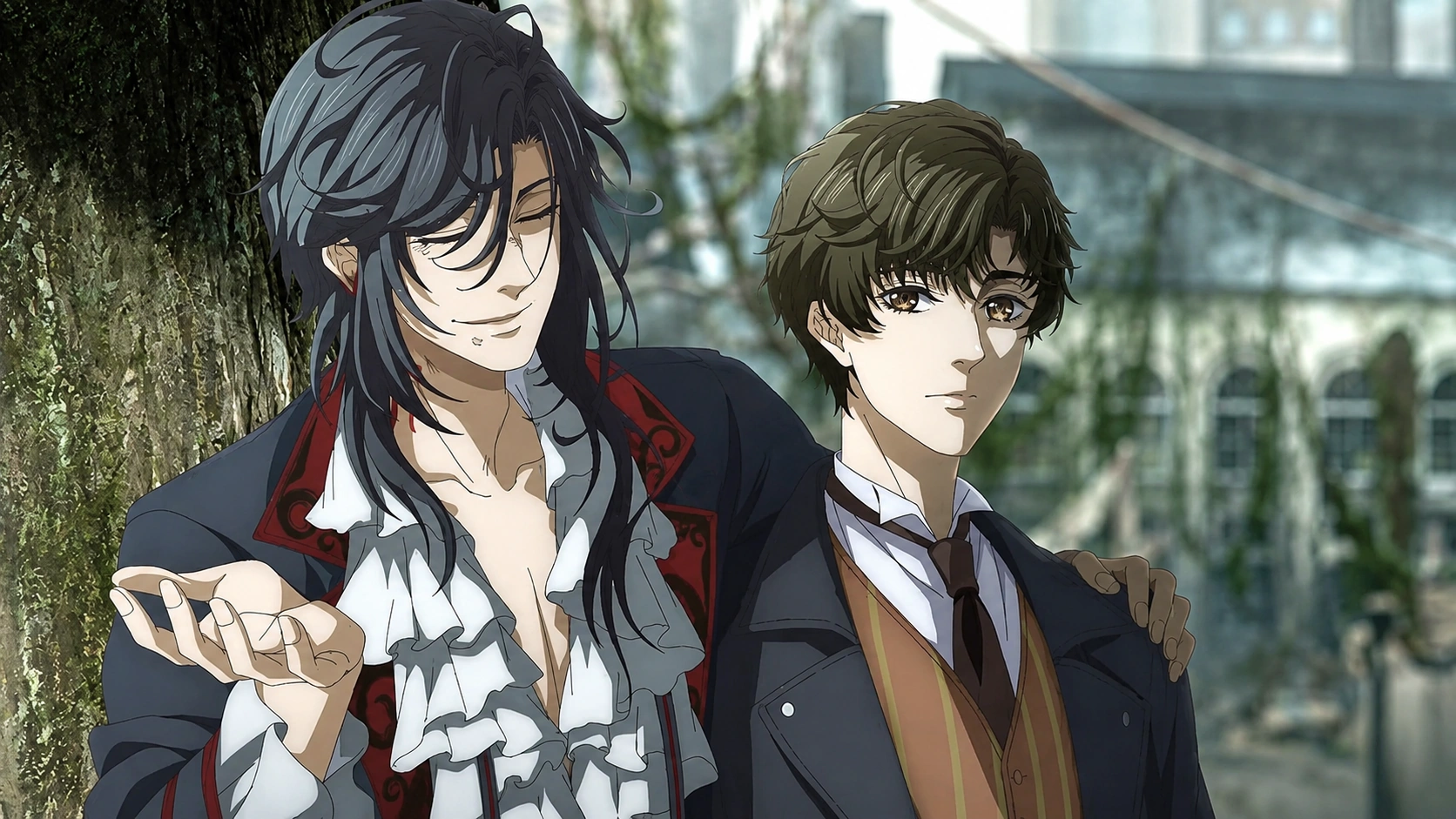
Imagine waking up in a stranger’s body in a gaslit Victorian city where magic is real, gods are dangerous, and secret societies will kill you for knowing too much. That’s where Zhou Mingrui finds himself at the start of Lord of the Mysteries — and his first survival instinct isn’t to fight. It’s to bluff.
Using nothing but his knowledge of tarot cards and sheer nerve, he constructs an elaborate throne room above a supernatural dimension called the Gray Fog, takes on the identity of a divine being, and calls himself The Fool.
Within minutes, the Lord of the Mysteries Tarot Club is born — one of the most brilliantly conceived secret organizations in all of anime history.
Since premiering on Crunchyroll in June 2025, Lord of the Mysteries has taken the anime community by storm. Its steampunk aesthetic, Lovecraftian horror, and deeply layered use of tarot symbolism have made it the most talked-about donghua of the year.
At the center of everything is the Tarot Club — a hidden society of powerful Beyonders who use Major Arcana card names as codenames and meet in a pocket dimension above reality.
Whether you just finished the first episode or you’ve already devoured the web novel, this is your complete guide to the Lord of the Mysteries Tarot Club: who the members are, what their tarot cards actually mean, how the Beyonder power system works, and why this show is unlike anything else airing right now.
What Is the Lord of the Mysteries Tarot Club?
The Tarot Club is a secret organization of supernatural beings called Beyonders, founded by Klein Moretti — the alias adopted by transmigrator Zhou Mingrui — in the space above the Gray Fog, a mysterious dimension between the living world and something far stranger.
How the Tarot Club Was Born (Completely by Accident)
Klein never planned to start a secret society. He was trying to recreate the occult ritual that pulled him from modern-day Earth into this Victorian alternate world, hoping it would send him back home. The ritual failed again — but instead of nothing, it accidentally dragged two strangers into the Gray Fog with him: Audrey Hall, an aristocratic young woman from Backlund, and Alger Wilson, a member of the Church of the Lord of Storms.
Caught off guard and desperate not to appear weak in front of two unknown Beyonders, Klein did what any quick-thinking isekai protagonist would do: he improvised. He used his imagination to furnish the Gray Fog with an elaborate, imposing throne room.
He sat down like he owned the place. He picked the name “The Fool” from a tarot card — card zero of the Major Arcana — and performed the role of a mysterious, all-knowing entity with total conviction.
It worked. Audrey gave the group its name: the Tarot Club. And in that moment of beautiful improvisation, one of anime’s greatest secret organizations was born.
How the Club Operates
The Tarot Club meets every Monday at 3 p.m. in the palace above the Gray Fog. Members join through prayer or ritual, their true identities completely hidden from one another. Each member adopts a codename taken from the Major Arcana of the tarot deck — a choice that is far more meaningful than it first appears, because in the world of Lord of the Mysteries, those card names carry real metaphysical weight over their bearers.
The Club functions as an information exchange, a resource-sharing network, and — over time — something far more significant.
What begins as three strangers trying to navigate a dangerous supernatural world quietly evolves into one of the most powerful covert organizations in the entire Fifth Epoch.
Members don’t all share the same religious or political affiliations. Some serve one Church on the surface while secretly loyal to The Fool. Others are pirates, nobles, or scholars.
This diversity of background gives the Tarot Club access to an extraordinarily broad range of resources, contacts, and intelligence — one of the key reasons it grows so rapidly in influence.
Tarot Symbolism in Lord of the Mysteries: How It Really Works
The tarot in Lord of the Mysteries is not window dressing. Author Cuttlefish That Loves Diving spent considerable effort grounding the show’s supernatural system in real tarot symbolism — and understanding that symbolism unlocks a whole new layer of the story.
The Major Arcana as a Power Map
In traditional tarot, the 22 Major Arcana cards represent the full range of human experience — from The Fool (card zero, representing beginnings and infinite potential) to The World (card 21, representing completion and mastery).
Together, they map what is sometimes called The Fool’s Journey: the path a soul takes from innocent beginning to total fulfillment.
In Lord of the Mysteries, this structure is literal. Each of the 22 Major Arcana cards corresponds to one of the 22 Standard Beyonder Pathways — distinct lines of supernatural evolution, each with its own potion sequences, abilities, and philosophical character.
The Tarot Club’s codenames are not just clever pseudonyms. They reveal, to anyone who can read them, the exact type of power each member wields.
Tarot Cards as Destiny — Not Just Identity
One of the show’s most intriguing conceits is that the codename a member chooses doesn’t just describe who they are — it actively shapes who they become. The tarot names carry what the lore calls “powerful fate” over their bearers. Choosing to be called Justice, or The Hermit, or The Sun is not a neutral act. It’s an alignment with an archetypal force that will pull at the person’s story from that moment forward.
This is also why the tarot cards scattered at crime scenes by the Tarot Club’s early public appearances carry such symbolic weight. The Emperor and Wheel of Fortune left on a villain’s body aren’t random — they’re statements about power, inevitability, and justice in the world’s occult language.
Real Tarot vs. Lord of the Mysteries Tarot
The show stays remarkably faithful to traditional tarot meanings while building its own mythological layer on top. Some standout examples:
- The Fool (card 0): Traditionally represents boundless potential, new beginnings, and the journey’s protagonist. In the show, Klein embodies this perfectly — he arrived with nothing, knows everything is uncertain, and yet his potential is genuinely limitless
- The Hanged Man (card 12): Traditionally represents sacrifice, surrender, and seeing the world from an inverted perspective. Alger Wilson, who serves one Church while secretly devoted to another, is the living definition of this card
- The Moon (card 18): Traditionally represents illusion, duality, and the hidden depths of the unconscious. Emlyn White, a vampire caught between human and monster, reflects this duality in every scene
- The Sun (card 19): Traditionally represents vitality, hope, and clarity after darkness. Derrick Berg — a young man from a city where the sun has not risen in centuries — carries this card as both irony and aspiration
- The World (card 21): Traditionally represents completion, integration, and mastery of all that came before. The figure who holds this codename in the Tarot Club carries one of the story’s most carefully constructed secrets
Lord of the Mysteries Tarot Club Members: Full Profiles
The Tarot Club starts with three members and grows to twelve over the course of the story. Each brings a radically different background, set of powers, and personal agenda — which is precisely what makes their collective story so compelling.
Klein Moretti — The Fool
Klein is the Tarot Club’s founder, convener, and — at least in the eyes of everyone else — its supreme mysterious deity. In reality, he’s a 24-year-old history graduate from modern-day Earth who is doing an extraordinary job faking it.
As The Fool, Klein operates along the Fool Pathway — one of the most versatile and dangerous Beyonder paths in existence. His abilities center on illusion, divination, marionette control, and manipulation of reality and perception. At higher sequences, Fool Pathway Beyonders are described as essentially impossible to capture, capable of folding time, conjuring miracles, and existing simultaneously in multiple realities.
Klein’s greatest weapon throughout the early story, however, isn’t any supernatural power. It’s his calm. He has an almost eerie ability to maintain composure under pressure, think several moves ahead, and project an authority he hasn’t technically earned yet. The Fool’s Journey in traditional tarot is the path toward mastery of all the arcanas — and Klein’s story is exactly that, beat by beat.
Audrey Hall — Justice
Audrey is a Backlund countess’s daughter: wealthy, cultured, and deeply bored with the gilded cage of upper-class Victorian life. She stumbled into the supernatural world out of genuine curiosity and a longing for something real. She chose the Spectator Pathway, which gives her terrifying insight into the emotional and psychological states of others — essentially making her a supernatural empath and, at higher sequences, a psychological manipulator of extraordinary subtlety.
Her card, Justice, fits her with precision. She has a deep, almost compulsive commitment to fairness and truth — even when the truth is uncomfortable and fairness costs her something.
She uses her aristocratic access and natural social intelligence as tools for good in ways that most people with her advantages never would. Justice is not just her codename. It’s her character.
Alger Wilson — The Hanged Man
Alger is a senior Beyonder in the Church of the Lord of Storms — and one of the most morally complex characters in the show. He joined the Tarot Club to gain access to resources and knowledge that his Church withholds, particularly around advancing his own Beyonder sequence. He respects The Fool deeply, but never fully lowers his guard.
The Hanged Man card — traditionally representing sacrifice, a reversed perspective, and devotion to something beyond immediate self-interest — describes Alger’s entire situation. He is simultaneously loyal and calculating, devoted and ambitious, self-sacrificing and ruthlessly goal-oriented. He operates from a perspective that is, quite literally, upside-down from most people’s expectations.
Derrick Berg — The Sun
Derrick comes from the City of Silver, a mysterious isolated settlement where the sun has not risen in living memory and the residents fight constantly against creatures of darkness.
His is one of the most emotionally affecting character arcs in the early story — a young man who has never seen sunlight, carrying the name of the card that represents it.
The Sun card in traditional tarot speaks to vitality, joy, and clarity emerging after a long period of darkness. The irony of Derrick’s codename — and the hope embedded in it — is one of Lord of the Mysteries’ most quietly powerful pieces of symbolism.
Emlyn White — The Moon
Emlyn is a vampire — or more precisely, a member of the Sanguine, beings who exist at the intersection of humanity and something ancient and inhuman. He is proud, occasionally arrogant, and deeply conflicted about his own nature. The Moon card, associated with illusion, duality, hidden depths, and the tension between what is seen and what is real, describes him almost uncomfortably well.
Cattleya — The Hermit
One of the Tarot Club’s most enigmatic members, Cattleya brings tremendous power and an almost absolute reserve to the group. The Hermit card traditionally represents wisdom earned through withdrawal from the world, deep introspection, and the quiet illumination that comes from looking inward. Cattleya embodies all of this — and her arc rewards patient viewers with revelations that recontextualize earlier events entirely.
Fors Wall — The Magician
Fors is a writer and one of the most quietly inspiring members of the Tarot Club. She became a Beyonder through sheer study and determination — no noble birth, no institutional backing, no lucky breaks.
The Magician card in traditional tarot represents the ability to transform raw materials into something extraordinary through skill, will, and focused attention. That is Fors’ story exactly. Her spatial manipulation abilities make her a far more formidable fighter than her literary persona suggests.
Leonard Mitchell — The Star
Leonard is a Nighthawk — a supernatural investigator in the Church of the Evernight Goddess — and one of the most layered characters in the entire cast. The Star card represents hope, inspiration, and the quiet light that guides travelers through darkness.
Leonard appears to be exactly this: a steady, reliable source of guidance within the Tarot Club. What lies beneath that surface is one of the story’s most carefully guarded secrets.
The Beyonder Power System: Why Tarot Makes It Work
Lord of the Mysteries features one of the most sophisticated and psychologically rich power systems in contemporary fantasy — and tarot is the architecture that holds it all together.
How Beyonders Work
Beyonders gain supernatural abilities by consuming specially formulated potions. Each potion belongs to one of 22 Standard Pathways (plus several Non-Standard Pathways), each corresponding to a Major Arcana card. Within each pathway, there are ten Sequences, numbered 9 through 0. Sequence 9 is entry level. Sequence 0 is effectively divine.
Advancement requires two things: the correct potion for the next Sequence, and the psychological “digestion” of the current one. That second requirement is what makes the system genuinely brilliant. You cannot simply consume your way to power. You have to internalize your current level — to understand, integrate, and master what the potion gave you — before your mind and spirit are stable enough to advance.
Beyonders who advance too fast without this digestion become “contaminated.” They start to lose themselves to the metaphysical essence of their pathway — the Hanged Man becoming obsessed with sacrifice, the Moon-path Beyonder sliding into delusion and paranoia. Madness isn’t a side effect. It’s the cost of ambition without wisdom.
Why This System Resonates So Deeply
The tarot has been used as a map of psychological and spiritual development for centuries. Carl Jung saw the Major Arcana as archetypes of the collective unconscious.
Modern tarot readers use the cards as tools for self-reflection, not fortune-telling. Lord of the Mysteries borrows this tradition and makes it literal: the cards are maps of what you become as you grow into your power.
The result is a power system where character development and supernatural advancement are the same thing. Klein doesn’t just get stronger. He becomes more fully himself — more aware of his potential, more integrated in his understanding of his situation, more genuinely wise.
The Fool’s Journey, in classical tarot, ends with The World: total mastery and wholeness. Lord of the Mysteries is the story of whether Klein can walk that entire path.
The Tarot Club as a Collective Journey
Viewed through this lens, the Tarot Club is not just a plot device or an information-sharing ring. It’s a group of people on parallel Fool’s Journeys, each walking a different path toward power, integration, and purpose.
The cards they carry aren’t just codenames — they’re destinations. The question the series asks, quietly but consistently, is whether each member can become the fullest, most realized version of the archetype they’ve chosen to embody.
Lord of the Mysteries Anime: Production, Reception, and What’s Coming Next
A Donghua That Set a New Standard
Produced by B.CMAY Pictures and backed by Tencent Video’s enormous resources, Lord of the Mysteries is one of the most technically ambitious 2D animated productions ever attempted outside Japan. The studio employed approximately 1,000 drawings per minute — well above the 400 to 700 typically used in conventional anime — resulting in motion that feels genuinely cinematic.
The show premiered on Crunchyroll, WeTV, and Muse on June 28, 2025, to immediate critical and audience acclaim. Its IMDB rating of 8.5 reflects a consensus that is rare for a first season: this is not just a solid debut. It’s a statement of intent from a studio and a source material that were both ready for a global audience.
Critical Response and Cultural Impact
Multiple major anime publications named Lord of the Mysteries the best fantasy donghua of 2025, with several critics arguing it surpasses Solo Leveling in narrative depth and thematic ambition.
The comparison is instructive: both are isekai, both feature a protagonist navigating a dangerous supernatural power system, and both look spectacular. But where Solo Leveling is a power fantasy, Lord of the Mysteries is a mystery — in every sense of the word.
The show’s Victorian steampunk setting, its debt to Lovecraftian cosmic horror, its intelligent pacing, and above all its sophisticated integration of tarot symbolism into every level of the narrative have attracted not just anime fans but fantasy readers, tarot enthusiasts, and people who had previously written off animation as a medium for serious storytelling. The Tarot Club is at the center of all of it.
Season 2 and Specials
Following the first season’s success, Tencent Video confirmed special episodes titled Lord of Mysteries Special: Prey, covering the City of Silver and Vice Admiral Qilango arcs from the novel. The first special — Lord of Mysteries Special: City of Silver — is set for release in June 2026, with two additional episodes (The Marked Hunt) to follow shortly after.
Season 2 is in production and expected to deepen the Tarot Club storylines considerably, particularly regarding the mysteries surrounding Klein’s true nature as The Fool, the histories of existing members, and the introduction of new Major Arcana codename holders who will dramatically shift the group’s dynamics.
For fans who came in through the anime, the wait for Season 2 is an excellent opportunity to explore the original web novel — one of the highest-rated Chinese web novels ever written, and the source of plot details that the anime hasn’t reached yet.
Why Lord of the Mysteries Is the Most Important Anime of 2025
It would be easy to file Lord of the Mysteries alongside other isekai and move on. That would be a mistake. What this show is doing with tarot, with psychological depth, and with the conventions of the genre is genuinely significant.
Tarot as Narrative Architecture
Most anime that use tarot use it decoratively — cool imagery, mysterious aesthetics. Lord of the Mysteries uses it structurally. The 22 Major Arcana provide the show’s entire framework of character, power, and meaning. Every significant character is a walking interpretation of their card. Every power level is a stage in a spiritual journey. Every plot development can be read as a tarot spread coming to life.
This creates a show that rewards attention in unusual ways. The more you know about traditional tarot — its history, its symbolism, its psychological uses — the richer the viewing experience becomes. But the show is also completely accessible to viewers who have never touched a tarot deck.
That balance between accessibility and depth is genuinely difficult to achieve, and Lord of the Mysteries achieves it almost effortlessly.
A Protagonist Worth Following
Klein Moretti is one of the most well-constructed isekai protagonists in recent memory. He is not overpowered at the start. He is not emotionally flat. He makes mistakes, feels fear, uses intelligence as his primary tool, and grows — genuinely, meaningfully, in ways that connect directly to the themes of his story.
The Fool’s Journey in traditional tarot is the story of a soul learning everything the universe has to teach. Klein’s journey in Lord of the Mysteries is exactly that, played completely straight and with total commitment. Watching him walk that path, one episode at a time, is one of the great pleasures in anime right now.
Final Thoughts on the Lord of the Mysteries Tarot Club
The Lord of the Mysteries Tarot Club is not just a story element. It’s the conceptual heart of the entire series — a place where tarot symbolism, supernatural power, character development, and narrative structure fuse into something wholly original and consistently extraordinary.
Each member of the Tarot Club is walking their own version of The Fool’s Journey. Each card they carry is both a description of who they are and a challenge about who they might become.
The Gray Fog palace where they meet is simultaneously a throne room, a support group, a marketplace, and a temple — a space outside ordinary reality where extraordinary people do the difficult, ongoing work of becoming more than they were.
If you haven’t started Lord of the Mysteries yet, the Tarot Club is reason enough to begin. And if you’re already watching, paying attention to the tarot symbolism woven through every episode will transform your experience of the show entirely.
The Fool has drawn his first card. The journey is just beginning.
FAQ: Lord of the Mysteries Tarot Club
Q1: What is the Tarot Club in Lord of the Mysteries?
The Tarot Club is a secret organization of Beyonders — beings with supernatural abilities — founded accidentally by protagonist Klein Moretti (The Fool) in a pocket dimension above the Gray Fog.
Members use Major Arcana tarot card names as codenames, meet weekly in this hidden space to share information and resources, and gradually evolve from a small survival group into one of the most powerful covert organizations in the story’s world.
Q2: Who are the members of the Lord of the Mysteries Tarot Club?
The founding members are Klein Moretti (The Fool), Audrey Hall (Justice), and Alger Wilson (The Hanged Man).
The club expands to include Derrick Berg (The Sun), Emlyn White (The Moon), Cattleya (The Hermit), Fors Wall (The Magician), Leonard Mitchell (The Star), and others. Each member’s codename corresponds to their Beyonder Pathway and reflects their character with remarkable symbolic precision.
Q3: Is Lord of the Mysteries on Crunchyroll?
Yes. Lord of the Mysteries premiered on Crunchyroll on June 28, 2025, alongside WeTV and Muse. The first season covers the opening arcs of the web novel. Special episodes are scheduled for June 2026, and Season 2 is in production.
Q4: Do you need to know tarot to understand Lord of the Mysteries?
Not at all — the show is completely accessible to viewers with no tarot knowledge. However, understanding traditional tarot symbolism significantly enriches the experience. Each member’s codename is a precise match for their personality, powers, and narrative arc. The more tarot literacy you bring, the more the story reveals. It rewards viewers at every level of familiarity with the subject.
Q5: What is the Beyonder system in Lord of the Mysteries and how does tarot connect to it?
Beyonders gain supernatural powers by consuming specially formulated potions. Each potion belongs to one of 22 Standard Pathways — each corresponding to a Major Arcana tarot card. Within each pathway are ten Sequences, from 9 (beginner) to 0 (effectively divine).
Advancing requires both the correct potion and psychological integration of the current Sequence. The tarot framework means each pathway has a distinct philosophical and symbolic character that shapes not just a Beyonder’s abilities but their entire worldview and arc.