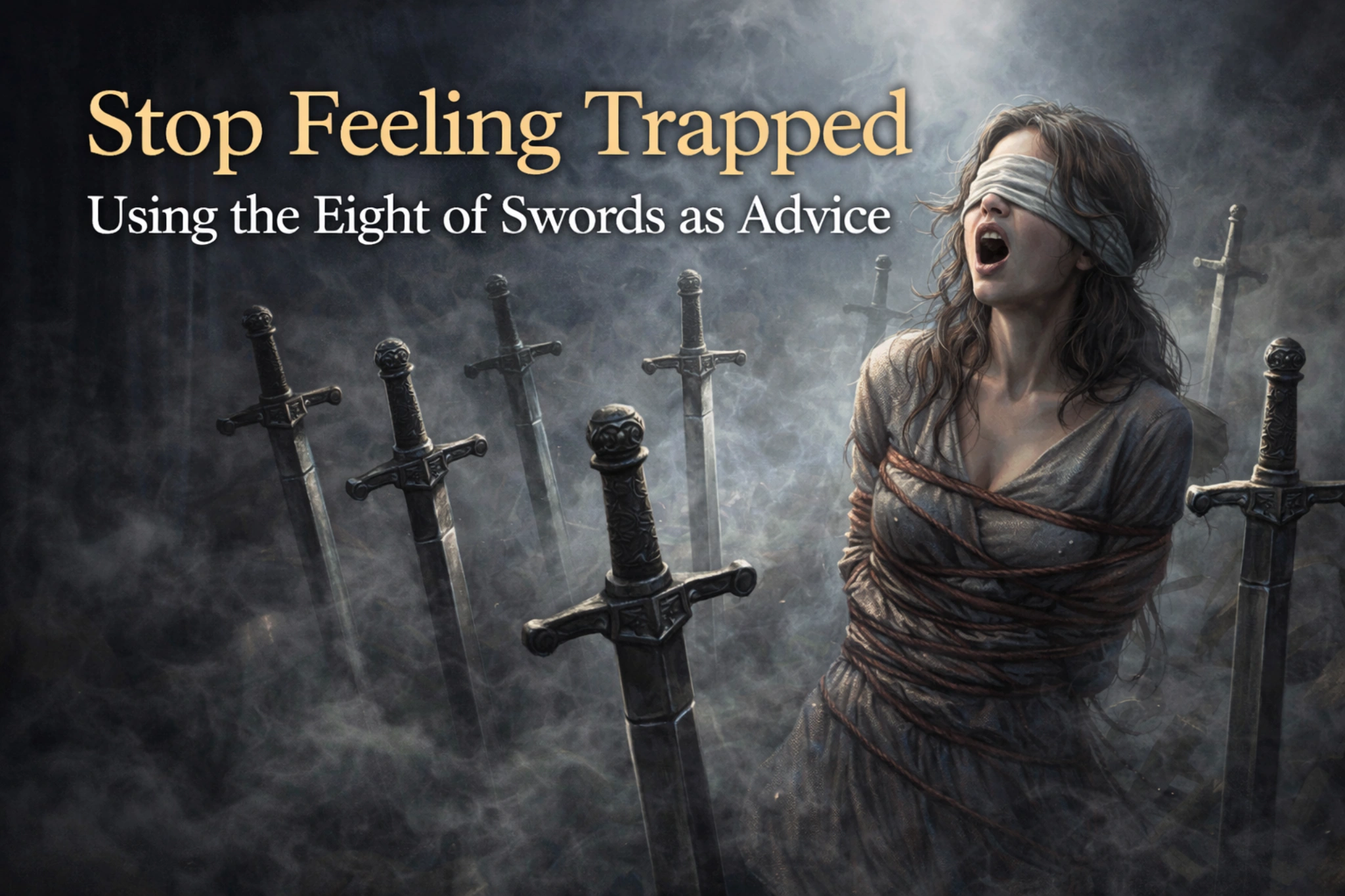
In the intricate tapestry of the Tarot, few cards evoke such a visceral sense of helplessness and confinement as the Eight of Swords.
Its iconic imagery—a blindfolded figure, bound by ropes, surrounded by eight swords, seemingly trapped in a muddy landscape—speaks volumes about mental imprisonment and self-imposed limitations.
Yet, to interpret this card solely as a harbinger of doom is to miss its profound and empowering message.
When the Eight of Swords as advice appears in a reading, it is not a sentence of perpetual bondage, but a powerful call to awakening, a spiritual directive to reclaim one’s agency and break free from the invisible chains of the mind.
This robust article will serve as a didactic, professional, and spiritual exploration of the Eight of Swords as advice. We will dissect its potent symbolism, delve into the psychological mechanisms that create mental traps, and offer practical, alchemical strategies for liberation.
We will explore how this card, often feared, can become a profound catalyst for personal growth, guiding individuals to transcend self-limiting beliefs in love, career, and spiritual development.
The high density of the keyword Eight of Swords as advice will be woven organically throughout the text, ensuring its authority on this transformative subject.
The Anatomy of a Mental Prison: Deconstructing the Eight of Swords
To truly harness the empowering advice of the Eight of Swords, we must first understand the elements that construct its mental prison. The Rider-Waite-Smith depiction is rich with symbolism, each detail offering a clue to our liberation.
The Blindfold: The Refusal to See
The most striking feature is the blindfold. This is not an external imposition but often a self-inflicted choice, symbolizing our refusal to see the truth of our situation [1]. It represents:
- Ignorance: A lack of awareness of available solutions or escape routes.
- Denial: The conscious or unconscious suppression of uncomfortable truths.
- Fear of Vision: The apprehension of what we might see if we dared to remove the blindfold—the responsibility, the effort, or the painful reality.
The Ropes: Self-Imposed Limitations
The ropes binding the figure are loose enough to be removed, yet the figure remains bound. This is the core message of the Eight of Swords as advice: the limitations are often self-imposed [2]. They represent:
- Limiting Beliefs: “I can’t,” “I’m not good enough,” “It’s impossible.”
- Victim Mentality: The belief that external circumstances or others are solely responsible for one’s predicament, leading to a sense of powerlessness.
- Fear of Freedom: The unconscious comfort in the familiar, even if it’s restrictive, because the unknown of freedom is more terrifying.
The Swords: The Prison of Thought
The eight swords surrounding the figure are not physically touching, yet they create a psychological barrier. These swords are the thoughts, judgments, and anxieties that create our mental prison [3]. They symbolize:
- Overthinking: The incessant mental chatter that paralyzes action.
- Negative Self-Talk: The internal critic that reinforces feelings of inadequacy.
- Fear of Judgment: The apprehension of what others might think if we step outside our perceived boundaries.
The Muddy Ground and Distant Castle: The Illusion of No Escape
The muddy, wet ground suggests a feeling of being stuck, bogged down, and unable to move. The distant castle, often interpreted as safety or a desired outcome, appears unreachable. This reinforces the illusion that there is no escape, even when a clear path is visible [4].
The Empowering Advice: Transmuting the Eight of Swords
When the Eight of Swords as advice appears, it is a profound invitation to engage in a process of mental and spiritual alchemy. It urges us to transform our perceived limitations into catalysts for growth and empowerment.
Step 1: Acknowledge the Illusion (Removing the Blindfold)
The first step in heeding the Eight of Swords as advice is to acknowledge that the prison is largely mental. This requires courage and brutal honesty.
- Self-Inquiry: Ask yourself: “What am I refusing to see? What truths am I avoiding?” Journaling can be a powerful tool here.
- Reality Check: Challenge your assumptions. Are your fears based on facts or on worst-case scenarios conjured by your mind? Seek objective feedback from trusted sources.
- Mindfulness: Practice observing your thoughts without judgment. Recognize that thoughts are not facts, and you are not your thoughts.
Step 2: Untie the Ropes (Challenging Limiting Beliefs)
Once the illusion is acknowledged, the next step is to actively untie the ropes of self-imposed limitations. This is where the Eight of Swords as advice becomes truly empowering.
- Identify Core Beliefs: What are the fundamental beliefs that keep you feeling trapped? Trace them back to their origins (childhood, past experiences).
- Cognitive Restructuring: Actively challenge and reframe negative thoughts. Replace “I can’t” with “How can I?” or “What if I could?”
- Small Actions: Take tiny, manageable steps outside your comfort zone. Each small victory weakens the ropes and builds confidence.
Step 3: Walk Away (Reclaiming Agency)
The figure in the Eight of Swords is surrounded by swords, but the path behind her is clear. The ultimate Eight of Swords as advice is to simply walk away from the mental prison [5].
- Set Boundaries: Learn to say no to situations, people, or demands that drain your energy and reinforce your sense of powerlessness.
- Seek Support: You don’t have to do it alone. A therapist, coach, or supportive friend can provide perspective and encouragement.
- Embrace Imperfection: The fear of failure often keeps us trapped. Understand that mistakes are part of the learning process, not a reflection of your worth.
The Eight of Swords in Context: Empowering Advice for Life Areas
The Eight of Swords as advice offers unique insights depending on the area of life being examined in a tarot reading.
In Career and Professional Life: Breaking Free from Stagnation
In a career reading, the Eight of Swords as advice often points to feelings of being stuck, undervalued, or unable to advance. The advice is to challenge the perceived limitations.
- “I feel trapped in my current job.” The advice is to identify the specific beliefs that are keeping you there. Is it fear of the unknown? A belief that you’re not qualified for anything else? The card urges you to explore options, update your skills, and network, even if it feels daunting.
- “I can’t speak up in meetings.” The advice is to practice assertive communication in smaller, safer settings. The swords represent the fear of judgment; the card encourages you to find your voice.
- “I’m afraid to start my own business.” The advice is to break down the overwhelming goal into tiny, actionable steps. The perceived risk is often greater than the actual risk.
In Love and Relationships: Escaping Toxic Cycles
When the Eight of Swords as advice appears in a love reading, it often highlights patterns of codependency, fear of abandonment, or staying in unfulfilling relationships due to self-limiting beliefs.
- “I keep attracting the wrong partners.” The advice is to examine your own internal narratives about love and self-worth. Are you unconsciously choosing partners who reinforce your belief that you are not worthy of true love?
- “I feel suffocated in my relationship.” The advice is to communicate your needs and set healthy boundaries. The ropes are loose; you have the power to create space and autonomy.
- “I’m afraid to leave a toxic relationship.” The advice is to build an external support system and develop a safety plan. The fear of being alone is often a greater prison than the relationship itself.
In Spiritual Growth: Transcending the Ego’s Illusions
In a spiritual reading, the Eight of Swords as advice is a powerful call to transcend the ego’s illusions and connect with the higher self. It speaks to the spiritual journey of self-liberation.
- “I feel disconnected from my spiritual path.” The advice is to identify the mental constructs or dogmas that are creating this separation. True spirituality is about direct experience, not rigid beliefs.
- “I’m afraid to fully embrace my spiritual gifts.” The advice is to release the fear of judgment or the belief that you are not “spiritual enough.” Your gifts are meant to be shared.
- “I feel overwhelmed by negative thoughts during meditation.” The advice is to observe these thoughts without attachment. The swords are just thoughts; they cannot harm you unless you give them power.
The Eight of Swords Reversed: The Breakthrough Moment
When the Eight of Swords as advice appears in its reversed position, it is a powerful indicator of a breakthrough. The blindfold is falling off, the ropes are loosening, and the figure is beginning to see a way out [6].
Signs of Liberation
- Self-Awareness: A sudden realization of the self-imposed nature of the prison.
- Taking Action: The courage to untie the ropes and step away from the limiting situation.
- New Perspectives: A willingness to challenge old beliefs and embrace new ways of thinking.
- Empowerment: A renewed sense of agency and control over one’s life.
Advice from the Reversed Eight of Swords
- Celebrate Small Victories: Acknowledge every step you take towards freedom.
- Maintain Vigilance: The old patterns of thought can easily return. Continue to practice mindfulness and self-awareness.
- Embrace the Unknown: The path to freedom may be uncertain, but it is always more expansive than the prison you leave behind.
Practical Tools for Mental Liberation: Your Alchemical Toolkit
To truly integrate the Eight of Swords as advice, a practical toolkit for mental liberation is essential. These are the alchemical steps to transform mental bondage into sovereign freedom.
The Blindfold Removal Ritual (Visualization)
- Find a Quiet Space: Sit comfortably and close your eyes.
- Visualize the Scene: Imagine yourself as the figure in the Eight of Swords, blindfolded and bound.
- Feel the Ropes: Acknowledge the feeling of being trapped, the frustration, the fear.
- The Inner Voice: Hear the Eight of Swords as advice whispering: “The ropes are loose. The blindfold can be removed.”
- Action: Slowly, in your mind’s eye, reach up and untie the blindfold. Feel the light, see the clear path behind you.
- Walk Away: Visualize yourself standing up, walking past the swords, and stepping onto solid ground, leaving the muddy prison behind.
The Sword-to-Pen Exercise (Journaling)
This exercise transforms the “swords” of negative thoughts into tools for clarity:
- Identify a Limiting Thought: Write down a thought that makes you feel trapped (e.g., “I’m not smart enough to get that promotion”).
- Challenge the Thought: Ask: “Is this 100% true? What evidence do I have against it? What would I tell a friend in this situation?”
- Reframe the Thought: Rewrite the thought in an empowering way (e.g., “I may need to learn new skills, but I am capable of growth and achieving my goals”).
The Grounding Breath (Mindfulness)
When feeling overwhelmed by mental chatter, use this simple breathing exercise:
- Inhale Deeply: Breathe in for a count of four, imagining you are drawing in calm, clear energy.
- Hold: Hold your breath for a count of four, allowing the energy to settle.
- Exhale Slowly: Exhale for a count of six, imagining you are releasing all the mental clutter, the swords of anxiety.
- Repeat: Continue for several minutes, focusing on the sensation of your breath and the feeling of release.
Your Path to Sovereign Freedom
The Eight of Swords as advice is one of the most profound and transformative messages the Tarot can offer.
It is a mirror reflecting our deepest fears and self-imposed limitations, but also a map guiding us to liberation.
By understanding its symbolism, engaging in conscious self-inquiry, and utilizing practical tools for mental alchemy, we can move from feeling trapped to embracing our sovereign freedom.
Remember, the swords are not physically binding you, and the blindfold is easily removed. The power to break free resides entirely within you.
Heed the Eight of Swords as advice, and step confidently onto the clear path that awaits, leaving the mental prison behind. Your freedom is not just a possibility; it is your birthright.
The Psychological Underpinnings: Why We Create Our Own Prisons
The Eight of Swords as advice is a profound mirror reflecting the psychological mechanisms that lead us to create and inhabit our own mental prisons. Understanding these underpinnings is crucial for true liberation.
Cognitive Distortions: The Blindfold of the Mind
Cognitive distortions are irrational thought patterns that lead us to perceive reality inaccurately. They are the fabric of the blindfold in the Eight of Swords [21].
- Catastrophizing: Assuming the worst possible outcome. “If I leave this job, I’ll never find another one.”
- All-or-Nothing Thinking: Seeing things in black and white. “If I’m not perfect, I’m a complete failure.”
- Personalization: Taking everything personally. “My boss didn’t say good morning, so he must be angry with me.”
- Mind Reading: Assuming you know what others are thinking. “They think I’m incompetent.”
The Eight of Swords as advice urges us to challenge these distortions, to question the validity of our internal narratives, and to seek a more balanced and realistic perspective.
Learned Helplessness: The Ropes of Passivity
Learned helplessness is a psychological state in which an individual has learned to behave helplessly, even when opportunities for help or escape are available. It is the psychological equivalent of the loose ropes in the Eight of Swords [22].
- Past Trauma: Repeated negative experiences can lead to the belief that one has no control over their circumstances.
- Lack of Agency: A feeling that one’s actions have no impact on outcomes, leading to passivity and resignation.
- External Locus of Control: Believing that external forces, rather than internal choices, dictate one’s life.
The Eight of Swords as advice is a powerful antidote to learned helplessness. It reminds us that even when circumstances are difficult, we always have the power to choose our response, to seek solutions, and to take action, however small.
The Comfort of the Familiar: The Muddy Ground of Stagnation
Paradoxically, the mental prison of the Eight of Swords can become a place of perverse comfort. The known, even if painful, can feel safer than the unknown of freedom. This is the muddy ground of stagnation [23].
- Fear of the Unknown: The anxiety associated with change, uncertainty, and new challenges.
- Secondary Gain: Unconscious benefits derived from staying in a difficult situation (e.g., sympathy, avoiding responsibility).
- Identity Attachment: Our sense of self can become intertwined with our struggles, making it difficult to imagine life without them.
The Eight of Swords as advice challenges us to question this false comfort, to recognize that true growth lies beyond the boundaries of our self-imposed limitations, and that the path to freedom, though initially daunting, leads to a more authentic and fulfilling existence.
Advanced Strategies for Liberation: Beyond the Basics
While the initial steps of acknowledging, challenging, and walking away are crucial, the Eight of Swords as advice also points to more advanced strategies for maintaining mental freedom and preventing relapse.
Cultivating Mental Resilience: The Unbreakable Spirit
Resilience is the ability to bounce back from adversity. For those who have experienced the Eight of Swords, cultivating resilience is key to preventing future mental entrapment [24].
- Mindfulness-Based Stress Reduction (MBSR): Regular practice helps to observe thoughts and emotions without getting entangled in them, creating a mental distance from the “swords.”
- Cognitive Behavioral Therapy (CBT) Techniques: Learning to identify and challenge negative thought patterns systematically. This is like having a mental toolkit to dismantle the blindfold and ropes.
- Developing a Growth Mindset: Believing that abilities and intelligence can be developed through dedication and hard work, rather than being fixed. This counters the limiting beliefs that keep us bound.
The Power of Narrative: Rewriting Your Story
The Eight of Swords as advice encourages us to become the authors of our own lives, rather than passive characters in a story written by our fears. This involves consciously rewriting our personal narratives [25].
- Identify the Victim Narrative: Recognize when you are telling a story where you are powerless and trapped.
- Shift to the Hero’s Journey: Reframe your experiences as challenges to be overcome, opportunities for growth, and moments of triumph. The figure in the Eight of Swords is on the cusp of their hero’s journey.
- Future Pacing: Visualize yourself already free, thriving, and empowered. This creates a mental blueprint for your desired reality.
Spiritual Practices for Sovereign Freedom
For a truly holistic approach, the Eight of Swords as advice also calls for spiritual practices that reinforce our inherent freedom and connection to a higher power.
- Affirmations of Freedom: Daily repetition of positive statements like “I am free,” “I am powerful,” “I choose my thoughts.” These are like spiritual mantras that cut through the ropes.
- Connection to Nature: Spending time in nature helps to ground us, reminding us of the vastness and interconnectedness of life, diminishing the perceived confinement of our mental prisons.
- Prayer or Meditation for Guidance: Asking for divine wisdom and strength to see the truth and find the courage to act. This invokes the higher wisdom that the High Priestess represents, guiding us through the Moon’s illusions.
Your Path to Sovereign Freedom (Expanded)
The Eight of Swords as advice is one of the most profound and transformative messages the Tarot can offer. It is a mirror reflecting our deepest fears and self-imposed limitations, but also a map guiding us to liberation.
By understanding its symbolism, engaging in conscious self-inquiry, and utilizing practical tools for mental alchemy, we can move from feeling trapped to embracing our sovereign freedom.
Remember, the swords are not physically binding you, and the blindfold is easily removed. The power to break free resides entirely within you. Heed the Eight of Swords as advice, and step confidently onto the clear path that awaits, leaving the mental prison behind.
Your freedom is not just a possibility; it is your birthright. This journey, guided by the Eight of Swords as advice, is a testament to the human spirit’s indomitable will to transcend perceived boundaries and claim its inherent power.
Embrace the challenge, for on the other side of the mental prison lies a world of boundless possibilities and authentic self-expression.