In a world increasingly driven by urgency and constant choice, the desire for immediate clarity has never been stronger.
The appeal of a direct, binary response is powerful—and this is precisely where Yes or No tarot finds its relevance.
Designed to deliver concise guidance, Yes or No tarot transforms complex questions into focused answers that support decisive action.
While traditional tarot reading excels at storytelling, symbolism, and layered insight, the Yes or No tarot approach offers a streamlined alternative for moments that demand speed and objectivity.
This in-depth guide explores the structure, techniques, interpretations, and ethical foundations of Yes or No tarot, enabling you to apply it responsibly while honoring the depth of the Tarot system.
The Mechanics of Yes or No Tarot
At its core, Yes or No tarot faces a fundamental challenge: translating a symbolic, multidimensional language into a clear binary outcome. To address this, experienced readers have developed structured methods that go beyond intuition alone, creating consistent frameworks that balance simplicity with meaning.
Method 1: The Upright/Reversed System
This is the most straightforward technique used in Yes or No tarot readings.
- Set the Intention: Before shuffling, the reader mentally assigns “Yes” to upright cards and “No” to reversed cards.
- Draw One Card: A single card is pulled with the question clearly stated.
- Interpret the Result: Upright indicates Yes; reversed indicates No.
- Limitation: This approach relies heavily on shuffling mechanics and largely ignores traditional Tarot meanings, effectively reducing the reading to chance. It is best reserved for low-impact, time-sensitive questions rather than meaningful life decisions.
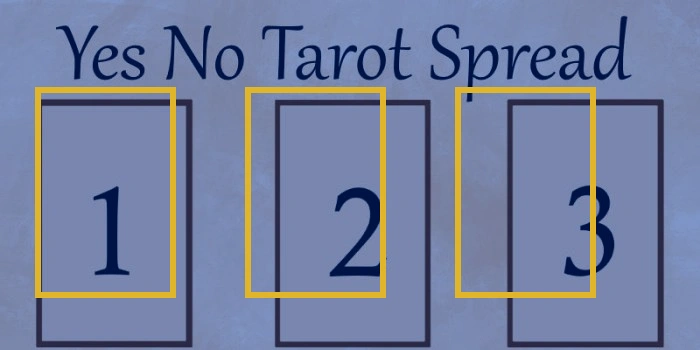
Method 2: The Majority Rule (Three-Card Spread)
This method introduces balance by allowing multiple cards to interact, offering a more reliable Yes or No tarot outcome.
- Draw Three Cards: All cards relate directly to the same question.
- Assign Values: Each card is interpreted as Yes, No, or Neutral/Maybe based on established Tarot meanings.
- Determine the Answer: The dominant energy prevails:
- Two or more Yes cards = YES
- Two or more No cards = NO
- Mixed or neutral distribution = MAYBE, suggesting reframing or delay
Method 3: The Elemental and Suit-Based System
This method draws on the elemental foundations of the Minor Arcana, adding context and consistency to Yes or No tarot readings.
| Suit | Element | Yes/No Value | Interpretive Logic |
|---|---|---|---|
| Wands | Fire | YES | Action, momentum, enthusiasm, initiative |
| Swords | Air | NO | Conflict, resistance, mental obstacles |
| Cups | Water | MAYBE | Emotional variability, relational factors |
| Pentacles | Earth | YES | Stability, manifestation, tangible results |
Major Arcana cards are typically treated as amplified signals—either strong Yes, strong No, or conditional outcomes depending on their archetypal force (e.g., The Sun as an emphatic Yes, The Tower as a decisive No).
The Definitive Yes or No Tarot Meanings List
Although Tarot interpretation is inherently intuitive, consistent energetic patterns allow for widely accepted Yes or No tarot classifications. The following tables reflect common consensus rooted in traditional symbolism.
Major Arcana Yes or No Meanings
| Card | Upright | Reversed |
|---|---|---|
| The Fool (0) | Yes, with awareness | No, due to recklessness |
| The Magician (I) | YES, empowered action | No, manipulation or blockage |
| The High Priestess (II) | Maybe, intuition needed | No, hidden factors |
| The Empress (III) | YES, growth and abundance | No, stagnation |
| The Emperor (IV) | YES, structure and authority | No, rigidity |
| The Lovers (VI) | YES, aligned choice | No, imbalance |
| Justice (XI) | Maybe, karma dependent | No, unfair outcome |
| Death (XIII) | No, necessary ending | Maybe, resistance |
| The Tower (XVI) | NO, disruption | No, avoidance |
| The Sun (XIX) | STRONG YES, success | Yes, with delays |
Minor Arcana Yes or No Meanings (Selected)
| Card | Upright | Reversed |
|---|---|---|
| Ace of Wands | STRONG YES, initiation | No, blocked start |
| Three of Cups | YES, celebration | No, excess |
| Five of Swords | NO, loss | No, unresolved |
| Ten of Pentacles | STRONG YES, security | Yes, with complications |
| Knight of Swords | YES, swift action | No, rash behavior |
The Limitations and Ethics of Yes or No Tarot
Despite its efficiency, Yes or No tarot must be used with discernment to preserve ethical integrity.
The Problem of Oversimplification
Life rarely conforms to binary outcomes. Yes or No tarot strips away narrative depth, which can result in incomplete understanding [1]. For major decisions involving relationships, finances, or long-term commitments, comprehensive Tarot spreads remain superior.
Tarot excels at revealing process, causality, and underlying dynamics—not merely outcomes. Skilled readers treat Yes or No tarot as an entry point, immediately following with clarifying questions that explore obstacles, timing, or personal responsibility.
Free Will and Ethical Responsibility
Ethically applied Yes or No tarot must always respect free will. Binary answers can exert psychological influence, risking dependency or fatalism.
- Best Practice: Frame every answer as reflective of current momentum, not destiny. Emphasize choice and agency.
- Third-Party Ethics: Avoid questions about another person’s intentions or feelings without consent. Redirect inquiries toward actions the querent controls.
Transforming Binary Answers into Meaningful Insight
The true mastery of Yes or No tarot lies in its integration with reflective inquiry.
The Follow-Up Card Method
Immediately after receiving a Yes, No, or Maybe, draw a second card to add depth.
| Answer | Follow-Up Question | Insight Focus |
|---|---|---|
| YES | How can I prepare for this outcome? | Strategy and readiness |
| NO | What is blocking this path? | Awareness and growth |
| MAYBE | What must I understand first? | Clarity and discernment |
This approach reframes Yes or No tarot as a coaching tool rather than a prediction device.
Precision in Question Design
Clear questions produce clearer Yes or No tarot responses.
- Positive Framing: Align Yes with the desired result.
- Action-Based Questions: Focus on choices within the querent’s control.
Yes or No Tarot as a Tool for Decisive Living
When applied skillfully, Yes or No tarot becomes a precise instrument for clarity, not a shortcut to fate. It excels at cutting through hesitation, offering direction when momentum matters.
By understanding interpretive systems, respecting ethical boundaries, and honoring traditional Tarot meanings, practitioners can use Yes or No tarot as a powerful complement to deeper tarot reading practices. It is not a replacement for complexity—but a focused lens that supports conscious, decisive living.
Advanced Yes or No Tarot: Understanding the Power of “Maybe”
The most profound Yes or No tarot insights often emerge from cards that resist certainty. “Maybe” is not ambiguity—it is instruction.
Identifying the Core “Maybe” Cards
Certain Major Arcana inherently suspend binary answers:
- The High Priestess (II): Inner knowledge required.
- Justice (XI): Outcome depends on balance and truth.
- The Hanged Man (XII): Pause and perspective shift.
- The Moon (XVIII): Unclear variables remain.
These cards signal that timing or awareness—not action—is required.
Interpreting Court Cards in Yes or No Tarot
Court Cards shift focus from outcome to behavior and maturity.
- Page: Maybe—early development.
- Knight: Yes—fast but volatile.
- Queen: Yes—conditional on emotional or mental mastery.
- King: Definite Yes—stability and authority.
Recognizing these distinctions elevates Yes or No tarot from novelty to disciplined spiritual practice—preserving the Tarot’s complexity even within its simplest form.